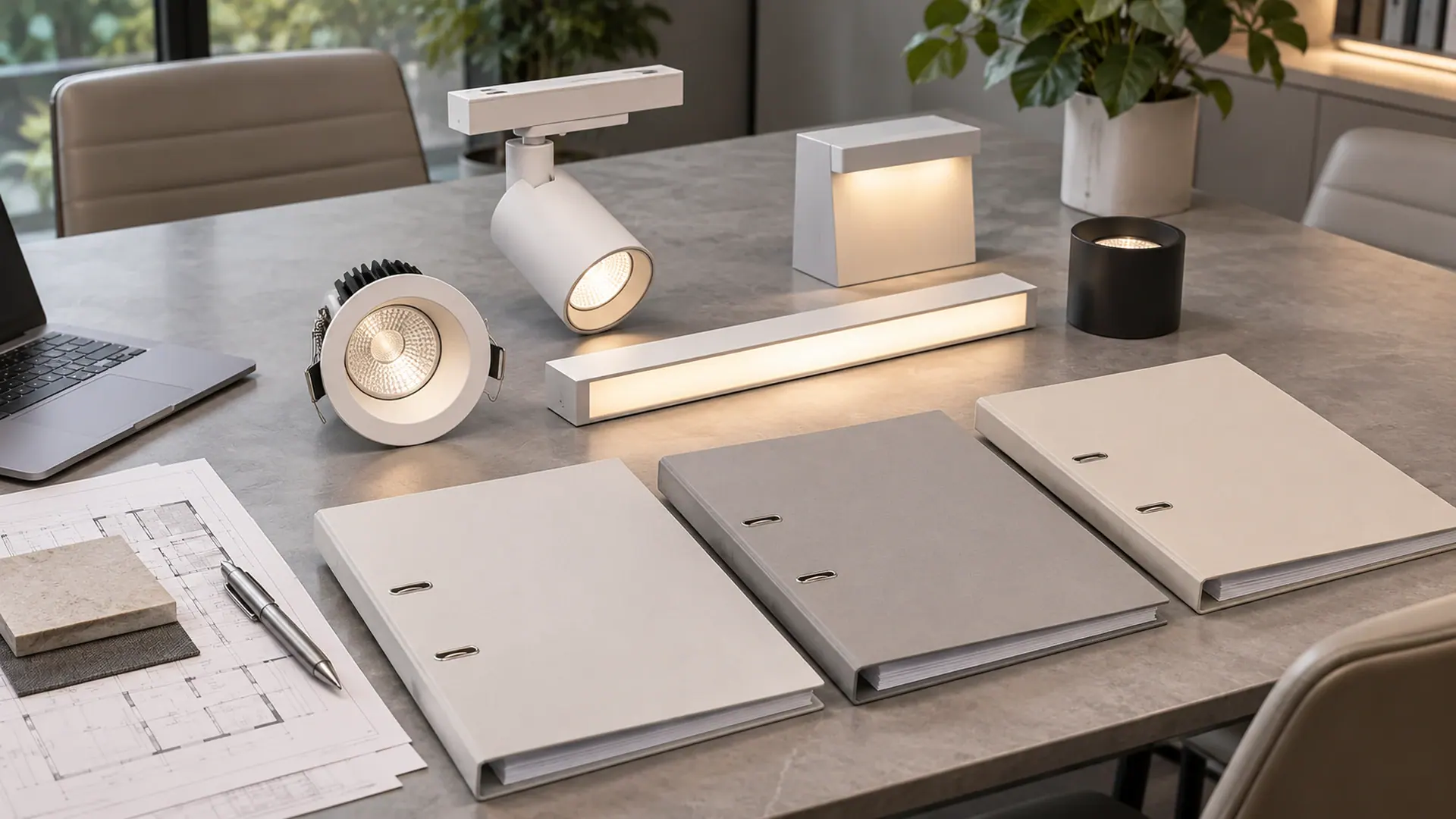
On a project schedule, the finish line is usually one word: “brass”. That word covers solid brass, brass-plated steel, clear-lacquered brass, aged brass and brass-coloured PVD, and each of them looks different after eighteen months in a hotel lobby. This guide sets out what the common luminaire finishes and materials actually are, how they age, why two batches of the same finish rarely match, and which compliance documents a UK, EU or Gulf project will ask for before handover. It is written for specifiers and procurement teams who have to defend a finish choice three years after installation.
1. Metal finishes and how they age
Five metal finishes account for almost every project luminaire. Each ages in a different way, and the ageing is the part that drawings never show.
Solid brass is a copper-zinc alloy, typically 60–63% copper. Left unlacquered it oxidises from a warm gold to a brown, then to a soft green-grey over one to three years indoors, faster in humid or coastal air. Lacquered, it holds its original colour until the coating fails, then ages unevenly where the lacquer has worn through. It is the most repairable finish: a worn brass surface can be re-polished and re-lacquered on site or in a workshop.
Brass-plated steel or zinc is a thin electroplated layer, usually 0.5–2 µm, over a cheaper substrate. It looks identical to solid brass on day one and fails differently: once the plating wears at high-touch points — switch collars, finial edges, the top of a handrail-adjacent sconce — the substrate shows through as a grey or rusty patch that cannot be polished back. It is the correct choice for a decorative fitting that nobody touches, and the wrong choice for anything within arm’s reach.
Bronze is copper-tin, darker and harder than brass, and used where a project wants a finish that starts dark and stays dark. It patinates more slowly and more evenly than brass and is the more forgiving choice for large flat surfaces.
Aluminium is almost always powder-coated or anodised. Powder coat is a 60–120 µm polymer layer in any RAL or bespoke colour; anodising is an electrochemical oxide layer, 10–25 µm, that is part of the metal rather than on top of it. Anodised aluminium does not chip, which makes it the better choice for exterior and high-wear applications; powder coat offers colours that anodising cannot reach.
Stainless steel comes in 304 and 316 grades. The difference matters at the coast: 316 contains 2–3% molybdenum, which raises its resistance to chloride pitting enough to survive salt spray where 304 will spot within a season.
| Finish | Appearance after 12 months | Repairable on site | Best application |
|---|---|---|---|
| Unlacquered solid brass | Darker, developing patina, uneven at first | Yes — polish and re-lacquer | Feature pendants, aged-look schemes |
| Lacquered solid brass | Unchanged if coating intact | Yes — strip and re-coat | Guestroom fittings, high-touch items |
| Brass-plated steel | Wear at contact points, substrate visible | No | Decorative, out of reach |
| PVD brass | Colour stable, very hard wearing | No | Public areas, door furniture, exterior |
| Powder-coated aluminium | Colour stable, chips at edges | Touch-up only | Coloured schemes, exterior |
| Anodised aluminium | Stable, no chipping | No | Exterior, industrial schemes |
| 316 stainless steel | Stable, resists salt pitting | Re-brushing only | Coastal and pool environments |
2. Brass, bronze and lacquer options
Once the metal is chosen, the finish on top of it drives both appearance and maintenance. There are four common routes.
Raw (living) brass is polished and left uncoated. It develops a patina naturally — roughly 3–6 months for the first visible darkening in a dry interior, 12–24 months for a fully even tone. The advantage is that the surface is honest and self-healing: no coating to chip. The disadvantage is that it never looks the same twice, and large flat surfaces patinate unevenly because the top of a plane collects dust and the bottom does not. On a project with 200 identical brass sconces, raw brass will show visible variation between a fitting near a window and one in a corridor.
Clear lacquer is a thin polymer coating — usually acrylic or polyurethane, 10–25 µm — that holds the polished colour. Indoors it lasts 3–5 years before yellowing or wearing at contact points. Outdoors, or in a pool or spa environment, expect 12–24 months before failure begins at edges. Lacquer is the right choice when a client wants “brass-coloured” and does not want the maintenance conversation; it is the wrong choice when the fitting will be touched daily and no one will re-lacquer it.
PVD (physical vapour deposition) deposits a hard ceramic-metal layer, typically titanium nitride or zirconium nitride, 0.5–3 µm thick. It is far harder than lacquer, does not yellow, and survives salt spray testing in the hundreds of hours. PVD gold and brass tones have improved considerably, but they remain slightly flatter and less warm than real brass, and the colour range is limited. Where a project wants a brass look with zero maintenance — hotel lift lobbies, exterior canopies, bathroom fittings — PVD is the pragmatic answer.
Powder coat gives full RAL control, 60–120 µm of film, and excellent colour consistency. It chips rather than wears, and a chip on an edge is very visible on a dark colour. Specify a polyester powder rather than an epoxy for exterior use; epoxy chalks and fades under UV.
Bronze and blackened brass are usually chemically darkened then lacquered or waxed. The depth of the black depends on how long the chemical is left on, which makes batch matching harder than for a plated finish — see section 4.
3. Stone, alabaster and glass
Mineral and glass components bring their own rules, and they are the ones most often left out of a finish schedule.
Alabaster is a fine-grained gypsum, translucent and soft — Mohs hardness around 1.5–2. It transmits light beautifully because the light scatters through the crystal structure rather than passing straight through, which is why an alabaster shade reads as a glowing mass rather than a hotspot. It also scratches with a fingernail and dissolves slowly in water, so alabaster is for dry interiors only. Specify a sealed alabaster or accept that humidity will cloud it.
Marble is opaque, so a marble shade or panel is normally lit from behind or below rather than through. Its porosity varies enormously by type: a dense Carrara absorbs under 1% water, a porous travertine can exceed 3%. For bathroom and wet-area use, specify stone with water absorption below 0.5% and seal it, or expect staining at the base where water collects.
Onyx sits between the two — translucent like alabaster, harder, and much more variable in colour. It is the most dramatic option and the hardest to match across a batch.
Glass for shades is either soda-lime, borosilicate or crystal. Borosilicate handles thermal shock far better and is the right choice for anything near a heat source. “Crystal” is a marketing term; technically it usually means lead glass with 24% or more lead oxide, which gives higher refractive index and a sharper sparkle but also requires REACH declaration in the EU.
| Material | Light behaviour | Water resistance | Handling risk |
|---|---|---|---|
| Alabaster | Translucent, diffuse glow | Poor — dry interiors only | Soft, scratches easily |
| Marble | Opaque, needs backlighting | Good if sealed, absorption <0.5% | Heavy, chips at edges |
| Onyx | Translucent, strong veining | Moderate, seal required | Fragile in thin sections |
| Soda-lime glass | Clear or opal | Good | Thermal shock risk |
| Borosilicate glass | Clear, heat resistant | Good | Low thermal shock risk |
| Lead crystal (PbO ≥24%) | High refractive index, sharp sparkle | Good | REACH declaration required |
4. Matching finishes across batches
Two fittings ordered six months apart from the same supplier will rarely match exactly, and the reason is rarely carelessness. Plating bath chemistry drifts, powder coat batches are tinted separately, chemical darkening depends on immersion time and temperature, and raw brass varies because the alloy itself varies.

Four practices keep a project consistent. First, order the full quantity in one batch wherever the programme allows, and ask the supplier to quote a batch quantity for the whole project rather than a per-phase quantity. Second, hold a signed master sample — a physical piece retained by the client, the designer and the supplier, referenced in the purchase order, so a dispute about “the same finish” has a physical answer. Third, specify a tolerance: for a metallic finish, “no visible difference at 1 m under 3000 K light” is a workable acceptance criterion; “identical” is not achievable and will be argued about. Fourth, for phase two, send the phase-one sample back and ask the supplier to match against it, not against their own current standard.
Where an exact match is critical — a feature chandelier in a lobby that is extended two years later — the honest answer is that the new pieces should be treated as a deliberate variant: change the scale or the placement so the difference reads as design rather than error. Pretending a two-year-later match will be invisible is how snagging lists get long.
5. Corrosion and environment
The environment a fitting is installed in decides the finish more than the design does, and the categories are worth stating explicitly in a schedule.
Interior, dry, controlled (guestrooms, offices, retail): almost any finish works. Lacquered brass and powder coat are fine. Expect 3–5 years before lacquer needs attention.
Interior, humid (bathrooms, spas, pools, kitchens): humidity accelerates lacquer failure and attacks plated substrates at edges. Use PVD, 316 stainless, or unlacquered brass with a planned maintenance cycle. Avoid brass-plated steel entirely.
Exterior, sheltered (canopies, porches): powder coat on aluminium, PVD, or 316 stainless. Lacquered brass will fail within 1–2 years at the coast.
Exterior, exposed or coastal: 316 stainless, anodised aluminium, or PVD. Salt spray testing is the relevant measure — ASTM B117 neutral salt spray, and for coastal specifiers a 480-hour rating is a reasonable minimum, with 720+ hours for direct sea exposure.
Two specific traps. First, dissimilar metals in contact: a brass screw into an aluminium body creates a galvanic couple, and the aluminium corrodes preferentially. Use isolating washers or matched metals. Second, pool ceilings: chlorine vapour is more aggressive than salt air in some ways, and it collects on the upward-facing surfaces of fittings. A downward-facing IP65 fitting with a PVD or 316 finish survives; a lacquered brass uplight above a pool will not.
6. Compliance documents: CE, UKCA, RoHS, ERP
A project’s compliance file is normally assembled twice — once at tender to prove the product can be supplied, and once at handover to prove what was supplied. The documents are the same both times.

CE marking is the manufacturer’s declaration that the luminaire meets the applicable EU directives, principally the Low Voltage Directive, EMC Directive and RoHS. It is supported by a Declaration of Conformity (DoC) naming the standards applied, and by test reports from a recognised laboratory. CE is self-declared for most luminaires; that does not make it optional, and a DoC without test reports behind it is not a compliance file.
UKCA is the post-Brexit UK equivalent. It has been required for most lighting products placed on the GB market since 2021, and CE marking has been extended as an accepted alternative in several rounds of delay — but the direction of travel is clear, and a UK hotel project will increasingly ask for UKCA or a dual-marked product. Check the current position at the time of the order rather than relying on a rule of thumb.
RoHS 2 (2011/65/EU as amended by 2015/863) restricts ten substances, including lead, mercury, cadmium and four phthalates. It applies to the whole luminaire, including the finish: a leaded crystal component or a cadmium-pigmented coating is a RoHS question, not just an aesthetic one.
REACH requires declaration of Substances of Very High Concern above 0.1% by weight in an article. Brass alloys and lead crystal are the usual watch items. Ask for a current SVHC declaration rather than an old one — the candidate list is updated twice a year.
Ecodesign (EU) 2019/2020 sets efficacy, flicker and standby limits for light sources and separate control gear. It is the regulation behind the A–G energy label and the flicker requirements now written into project specifications. The companion regulation 2021/341 sets out the test methods.
For Gulf projects, SASO and SABER for Saudi Arabia and ESMA registration with the G-mark for the UAE sit on top of the above; for Turkey, CE is accepted but customs frequently asks for additional test documentation. Those are covered in a separate guide.
At handover, collect: DoC for each product family, test reports matching the DoC’s standards, RoHS and REACH declarations, the energy label and product information sheet for each light source, and a schedule mapping each certificate to the product code actually installed. A certificate file that cannot be tied to a specific delivered fitting is the most common reason a handover gets held up.
Next step
Finish and compliance decisions are cheap to change on a sample board and expensive to change after the purchase order. If you are building a schedule for a hotel, restaurant or residential project, we can send physical samples of brass, bronze, PVD, stone and glass finishes, together with the current declaration pack for the fixtures you are considering. Request a finish sample board through our capabilities page, see the full document set on compliance and sustainability, or browse decorative lighting to see how these finishes are applied.