Custom Chandeliers for Hotel & Commercial Projects
Develop a feature fixture around the space and the project brief.
A custom chandelier needs a clear relationship between the intended appearance and the details required for production, transport and installation. Qilux reviews the brief with designers and project teams so the proposal can address those decisions together.
Define the design intent
Start with the overall form, proportions and visual references. Identify which details are essential and which may be developed as options. Images help communicate an idea, but dimensions and relevant ceiling information are needed to define the proposed fixture.
Tell us how the chandelier relates to the space: a central lobby feature, a linear restaurant composition or a repeated arrangement in a ballroom. The design can then be reviewed against its intended position rather than considered as an isolated object.
Review dimensions and installation conditions
Provide the proposed fixture dimensions, ceiling height, suspension conditions and access information available from the project team. Confirm which party is responsible for structural assessment, site measurements and installation.
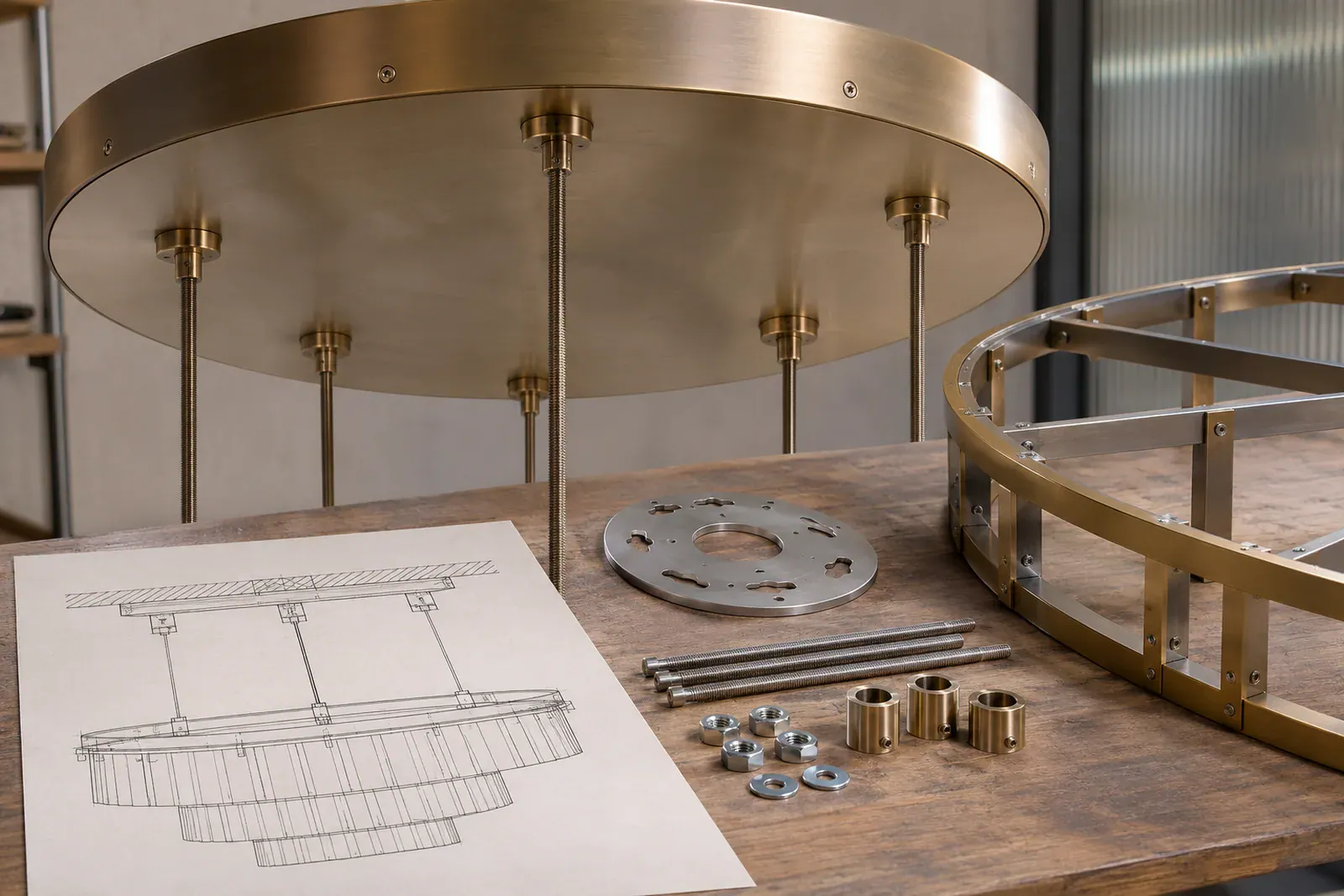
Mounting details, lifting access, assembly sequence and maintenance access may need specialist coordination. A conceptual drawing or image is not a structural assessment. Final site requirements must be reviewed by the appropriately qualified project parties.
Agree the material and finish reference
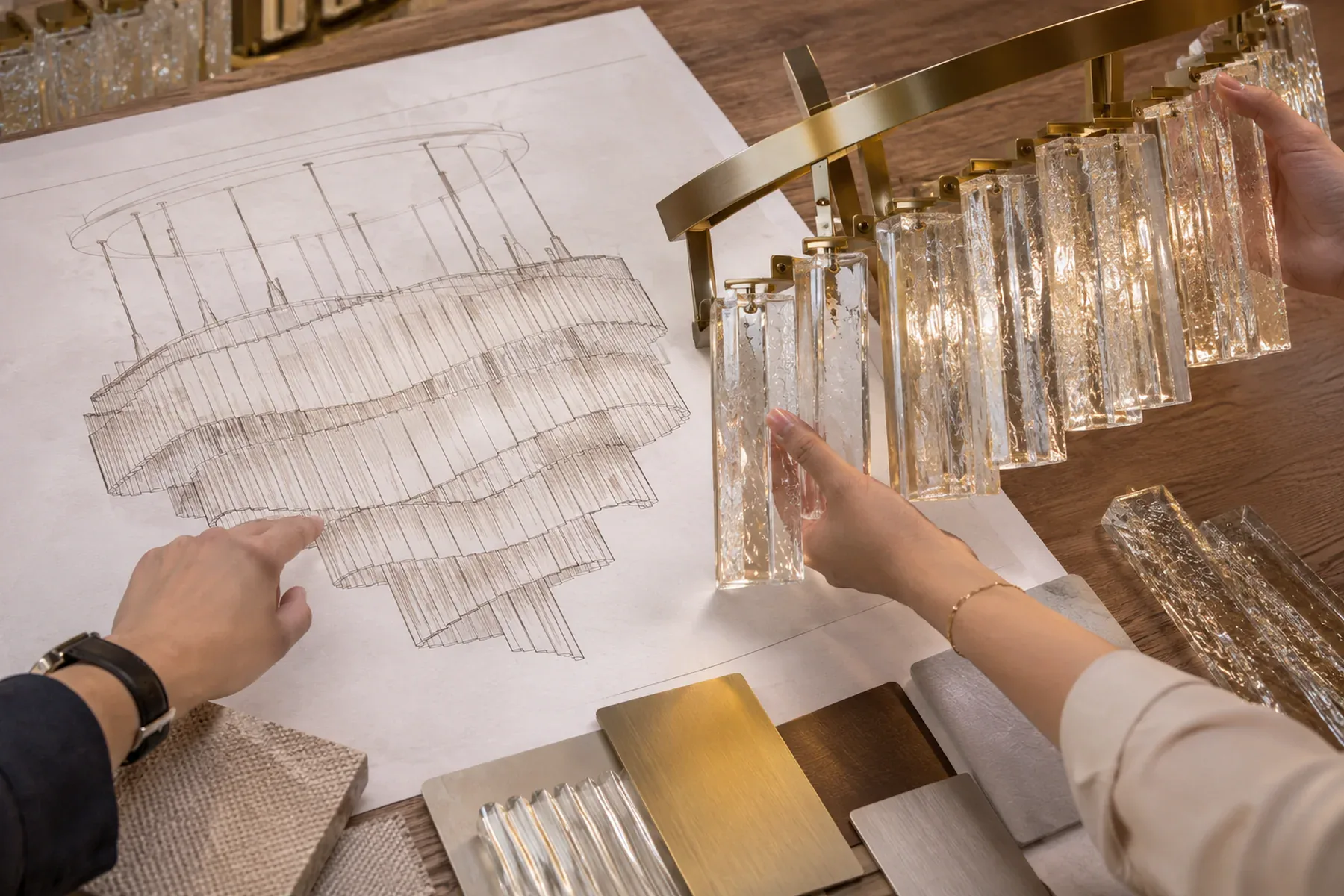
Metalwork, glass, diffusers and other decorative components should be considered as an assembly. A small finish sample may communicate colour and texture, while a component or section sample can help the team review scale, joints and the appearance of light through the material.
The appropriate sample depends on the fixture. Agree what it represents and which decisions remain open. If the design changes after review, update the drawing and sample record before production proceeds.
Develop the production scope
The confirmed brief should identify the version of the design, dimensions, selected materials, finish references and light-source requirements. Any control requirements need to be assessed against the actual proposed components.
For large or complex fixtures, discuss how the fitting will be divided for transport, how parts will be identified and which information the installation team will need. These decisions can affect both packaging and on-site coordination.
Plan packing and handover
Fragile decorative parts and mounting hardware need appropriate separation and protection. Discuss crate or carton arrangements, delivery access, unpacking responsibilities and spare components as part of the order.
Available assembly drawings, installation instructions and maintenance information are confirmed for the selected fixture. Additional installation support is agreed separately for the project scope.
Begin with your project information
Send reference images or drawings, approximate size, quantity, intended location and target dates. Include ceiling or mounting information if available, and identify any unresolved technical decisions.