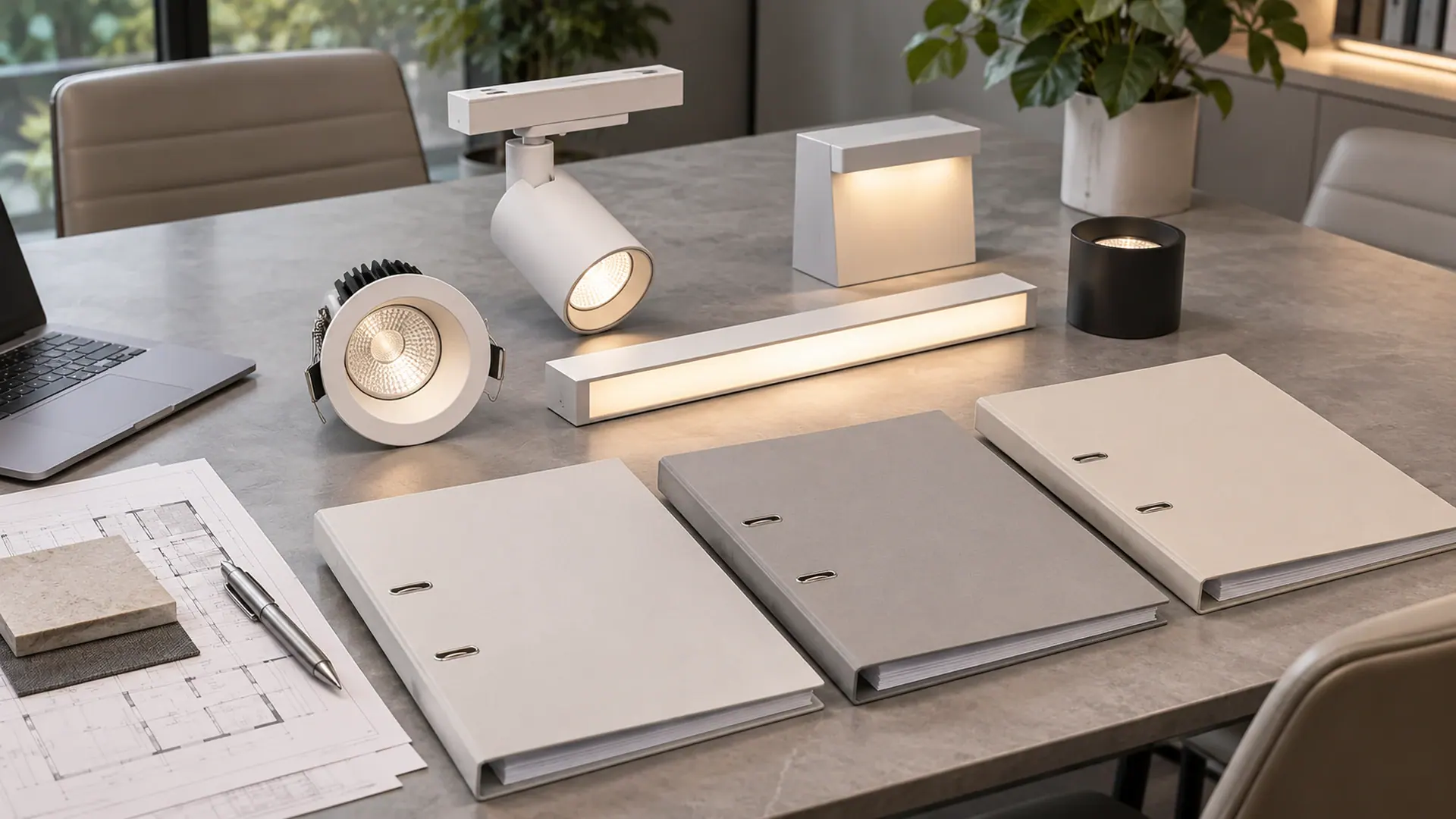

Dans un calendrier de projet, la finition se résume généralement à un seul mot : “ laiton ”. Ce terme englobe le laiton massif, l’acier plaqué laiton, le laiton verni transparent, le laiton vieilli et le PVD couleur laiton, qui présentent chacun un aspect différent après dix-huit mois dans le hall d’un hôtel. Ce guide explique en quoi consistent réellement les finitions et matériaux courants des luminaires, comment ils vieillissent, pourquoi deux lots d’une même finition correspondent rarement parfaitement, et quels documents de conformité seront demandés avant la réception d’un projet au Royaume-Uni, dans l’UE ou dans le Golfe. Il s’adresse aux prescripteurs et aux équipes chargées des achats qui devront défendre un choix de finition trois ans après l’installation.
1. Finitions métalliques et vieillissement
Cinq finitions métalliques couvrent presque tous les luminaires de projet. Chacune vieillit différemment, et les dessins ne montrent jamais cette évolution.
Laiton massif est un alliage de cuivre et de zinc, généralement composé de 60 à 63 % de cuivre. Non verni, il s’oxyde et passe d’un ton doré chaud au brun, puis à un doux gris-vert en un à trois ans à l’intérieur, plus rapidement en milieu humide ou côtier. Verni, il conserve sa couleur d’origine jusqu’à la dégradation du revêtement ; il vieillit alors de façon irrégulière aux endroits où le vernis s’est usé. C’est la finition la plus facile à réparer : une surface en laiton usée peut être repolie et revernie sur site ou en atelier.
Acier ou zinc plaqué laiton est recouvert d’une fine couche électrodéposée, généralement de 0,5 à 2 µm, sur un substrat moins coûteux. Son aspect est identique à celui du laiton massif le premier jour, mais son vieillissement est différent : lorsque le placage s’use aux endroits fréquemment touchés — collerettes d’interrupteur, bords de faîteau, partie supérieure d’une applique près d’une rampe — le substrat apparaît sous forme d’une tache grise ou rouillée qui ne peut pas être éliminée par polissage. C’est le bon choix pour un luminaire décoratif que personne ne touche, et le mauvais choix pour tout élément à portée de main.
Bronze est un alliage de cuivre et d’étain, plus foncé et plus dur que le laiton. Il est utilisé lorsqu’un projet exige une finition foncée dès le départ et qui le reste. Il se patine plus lentement et plus uniformément que le laiton et constitue un choix plus tolérant pour les grandes surfaces planes.
Aluminium est presque toujours thermolaqué ou anodisé. Le thermolaquage forme une couche polymère de 60 à 120 µm, dans n’importe quelle couleur RAL ou personnalisée ; l’anodisation crée une couche d’oxyde électrochimique de 10 à 25 µm, intégrée au métal plutôt que déposée à sa surface. L’aluminium anodisé ne s’écaille pas, ce qui en fait le meilleur choix pour les applications extérieures et soumises à une forte usure ; le thermolaquage offre des couleurs impossibles à obtenir par anodisation.
Acier inoxydable existe en nuances 304 et 316. La différence est importante en bord de mer : la nuance 316 contient 2 à 3 % de molybdène, ce qui renforce suffisamment sa résistance à la corrosion par piqûres due aux chlorures pour qu’elle résiste aux embruns salins, là où la nuance 304 se tache en l’espace d’une saison.
| Finition | Aspect après 12 mois | Réparable sur site | Meilleure application |
|---|---|---|---|
| Laiton massif non verni | Plus foncé, patine en cours de développement, d’abord irrégulière | Oui — polir et revernir | Suspensions décoratives, projets recherchant un aspect vieilli |
| Laiton massif laqué | Inchangé si le revêtement est intact | Oui — décaper et appliquer une nouvelle couche | Équipements des chambres, éléments fréquemment touchés |
| Acier plaqué laiton | Usure aux points de contact, substrat visible | Non | Décoratif, hors de portée |
| Laiton PVD | Couleur stable, très résistant à l’usure | Non | Espaces publics, quincaillerie de porte, extérieur |
| Aluminium thermolaqué | Couleur stable, éclats sur les bords | Retouches uniquement | Schémas colorés, extérieur |
| Aluminium anodisé | Stable, sans écaillage | Non | Extérieur, aménagements industriels |
| Acier inoxydable 316 | Stable, résiste à la corrosion par piqûres due au sel | Brossage à nouveau uniquement | Environnements côtiers et piscines |
2. Options en laiton, bronze et avec finition laquée
Une fois le métal choisi, la finition appliquée détermine à la fois son apparence et son entretien. Il existe quatre options courantes.
Laiton brut (vivant) Il est poli et laissé sans revêtement. Il se patine naturellement : il faut compter environ 3 à 6 mois pour voir apparaître les premiers signes de ternissement dans un intérieur sec, et 12 à 24 mois pour obtenir une teinte uniforme. Son avantage : la surface reste authentique et se régénère d’elle-même, sans revêtement susceptible de s’écailler. Son inconvénient : elle ne présente jamais exactement le même aspect, et les grandes surfaces planes se patinent de manière irrégulière, car le dessus accumule la poussière, contrairement au dessous. Dans un projet comportant 200 appliques identiques en laiton, le laiton brut présentera des variations visibles entre un luminaire près d’une fenêtre et un autre dans un couloir.
Vernis transparent Il s’agit d’une fine couche de polymère — généralement de l’acrylique ou du polyuréthane, d’une épaisseur de 10 à 25 µm — qui préserve la couleur du métal poli. En intérieur, elle dure 3 à 5 ans avant de jaunir ou de s’user aux points de contact. En extérieur, ou dans un environnement de piscine ou de spa, il faut s’attendre à ce qu’elle commence à se dégrader au niveau des bords après 12 à 24 mois. Le vernis est le bon choix si le client souhaite une finition “ couleur laiton ” et préfère ne pas avoir à se soucier de l’entretien ; il ne convient pas si le luminaire est touché quotidiennement et que personne ne le revernis.
PVD (dépôt physique en phase vapeur) Cette technique dépose une couche céramo-métallique dure, généralement en nitrure de titane ou en nitrure de zirconium, d’une épaisseur de 0,5 à 3 µm. Elle est beaucoup plus résistante que le vernis, ne jaunit pas et résiste aux essais au brouillard salin pendant plusieurs centaines d’heures. Les teintes or et laiton en PVD se sont nettement améliorées, mais elles restent légèrement plus mates et moins chaleureuses que le laiton véritable, et le choix de couleurs est limité. Pour les projets exigeant un aspect laiton sans aucun entretien — halls d’ascenseurs d’hôtel, auvents extérieurs, robinetterie de salle de bains — le PVD est la solution pragmatique.
Revêtement en poudre gives full RAL control, 60–120 µm of film, and excellent colour consistency. It chips rather than wears, and a chip on an edge is very visible on a dark colour. Specify a polyester powder rather than an epoxy for exterior use; epoxy chalks and fades under UV.
Bronze and blackened brass are usually chemically darkened then lacquered or waxed. The depth of the black depends on how long the chemical is left on, which makes batch matching harder than for a plated finish — see section 4.
3. Stone, alabaster and glass
Mineral and glass components bring their own rules, and they are the ones most often left out of a finish schedule.
Alabaster is a fine-grained gypsum, translucent and soft — Mohs hardness around 1.5–2. It transmits light beautifully because the light scatters through the crystal structure rather than passing straight through, which is why an alabaster shade reads as a glowing mass rather than a hotspot. It also scratches with a fingernail and dissolves slowly in water, so alabaster is for dry interiors only. Specify a sealed alabaster or accept that humidity will cloud it.
Marbre is opaque, so a marble shade or panel is normally lit from behind or below rather than through. Its porosity varies enormously by type: a dense Carrara absorbs under 1% water, a porous travertine can exceed 3%. For bathroom and wet-area use, specify stone with water absorption below 0.5% and seal it, or expect staining at the base where water collects.
Onyx sits between the two — translucent like alabaster, harder, and much more variable in colour. It is the most dramatic option and the hardest to match across a batch.
verre for shades is either soda-lime, borosilicate or crystal. Borosilicate handles thermal shock far better and is the right choice for anything near a heat source. “Crystal” is a marketing term; technically it usually means lead glass with 24% or more lead oxide, which gives higher refractive index and a sharper sparkle but also requires REACH declaration in the EU.
| Matériau | Light behaviour | Water resistance | Handling risk |
|---|---|---|---|
| Alabaster | Translucent, diffuse glow | Poor — dry interiors only | Soft, scratches easily |
| Marbre | Opaque, needs backlighting | Good if sealed, absorption <0.5% | Heavy, chips at edges |
| Onyx | Translucent, strong veining | Moderate, seal required | Fragile in thin sections |
| Soda-lime glass | Clear or opal | Good | Thermal shock risk |
| Borosilicate glass | Clear, heat resistant | Good | Low thermal shock risk |
| Lead crystal (PbO ≥24%) | High refractive index, sharp sparkle | Good | REACH declaration required |
4. Matching finishes across batches
Two fittings ordered six months apart from the same supplier will rarely match exactly, and the reason is rarely carelessness. Plating bath chemistry drifts, powder coat batches are tinted separately, chemical darkening depends on immersion time and temperature, and raw brass varies because the alloy itself varies.

Four practices keep a project consistent. First, order the full quantity in one batch wherever the programme allows, and ask the supplier to quote a batch quantity for the whole project rather than a per-phase quantity. Second, hold a signed master sample — a physical piece retained by the client, the designer and the supplier, referenced in the purchase order, so a dispute about “the same finish” has a physical answer. Third, specify a tolerance: for a metallic finish, “no visible difference at 1 m under 3000 K light” is a workable acceptance criterion; “identical” is not achievable and will be argued about. Fourth, for phase two, send the phase-one sample back and ask the supplier to match against it, not against their own current standard.
Where an exact match is critical — a feature chandelier in a lobby that is extended two years later — the honest answer is that the new pieces should be treated as a deliberate variant: change the scale or the placement so the difference reads as design rather than error. Pretending a two-year-later match will be invisible is how snagging lists get long.
5. Corrosion and environment
The environment a fitting is installed in decides the finish more than the design does, and the categories are worth stating explicitly in a schedule.
Interior, dry, controlled (guestrooms, offices, retail): almost any finish works. Lacquered brass and powder coat are fine. Expect 3–5 years before lacquer needs attention.
Interior, humid (bathrooms, spas, pools, kitchens): humidity accelerates lacquer failure and attacks plated substrates at edges. Use PVD, 316 stainless, or unlacquered brass with a planned maintenance cycle. Avoid brass-plated steel entirely.
Exterior, sheltered (canopies, porches): powder coat on aluminium, PVD, or 316 stainless. Lacquered brass will fail within 1–2 years at the coast.
Exterior, exposed or coastal: 316 stainless, anodised aluminium, or PVD. Salt spray testing is the relevant measure — ASTM B117 neutral salt spray, and for coastal specifiers a 480-hour rating is a reasonable minimum, with 720+ hours for direct sea exposure.
Two specific traps. First, dissimilar metals in contact: a brass screw into an aluminium body creates a galvanic couple, and the aluminium corrodes preferentially. Use isolating washers or matched metals. Second, pool ceilings: chlorine vapour is more aggressive than salt air in some ways, and it collects on the upward-facing surfaces of fittings. A downward-facing IP65 fitting with a PVD or 316 finish survives; a lacquered brass uplight above a pool will not.
6. Compliance documents: CE, UKCA, RoHS, ERP
A project’s compliance file is normally assembled twice — once at tender to prove the product can be supplied, and once at handover to prove what was supplied. The documents are the same both times.

CE marking is the manufacturer’s declaration that the luminaire meets the applicable EU directives, principally the Low Voltage Directive, EMC Directive and RoHS. It is supported by a Declaration of Conformity (DoC) naming the standards applied, and by test reports from a recognised laboratory. CE is self-declared for most luminaires; that does not make it optional, and a DoC without test reports behind it is not a compliance file.
UKCA is the post-Brexit UK equivalent. It has been required for most lighting products placed on the GB market since 2021, and CE marking has been extended as an accepted alternative in several rounds of delay — but the direction of travel is clear, and a UK hotel project will increasingly ask for UKCA or a dual-marked product. Check the current position at the time of the order rather than relying on a rule of thumb.
RoHS 2 (2011/65/EU as amended by 2015/863) restricts ten substances, including lead, mercury, cadmium and four phthalates. It applies to the whole luminaire, including the finish: a leaded crystal component or a cadmium-pigmented coating is a RoHS question, not just an aesthetic one.
REACH requires declaration of Substances of Very High Concern above 0.1% by weight in an article. Brass alloys and lead crystal are the usual watch items. Ask for a current SVHC declaration rather than an old one — the candidate list is updated twice a year.
Ecodesign (EU) 2019/2020 sets efficacy, flicker and standby limits for light sources and separate control gear. It is the regulation behind the A–G energy label and the flicker requirements now written into project specifications. The companion regulation 2021/341 sets out the test methods.
For Gulf projects, SASO and SABER for Saudi Arabia and ESMA registration with the G-mark for the UAE sit on top of the above; for Turkey, CE is accepted but customs frequently asks for additional test documentation. Those are covered in a separate guide.
At handover, collect: DoC for each product family, test reports matching the DoC’s standards, RoHS and REACH declarations, the energy label and product information sheet for each light source, and a schedule mapping each certificate to the product code actually installed. A certificate file that cannot be tied to a specific delivered fitting is the most common reason a handover gets held up.
Étape suivante
Finish and compliance decisions are cheap to change on a sample board and expensive to change after the purchase order. If you are building a schedule for a hotel, restaurant or residential project, we can send physical samples of brass, bronze, PVD, stone and glass finishes, together with the current declaration pack for the fixtures you are considering. Request a finish sample board through notre page consacrée à nos compétences, see the full document set on compliance and sustainability, or browse decorative lighting to see how these finishes are applied.