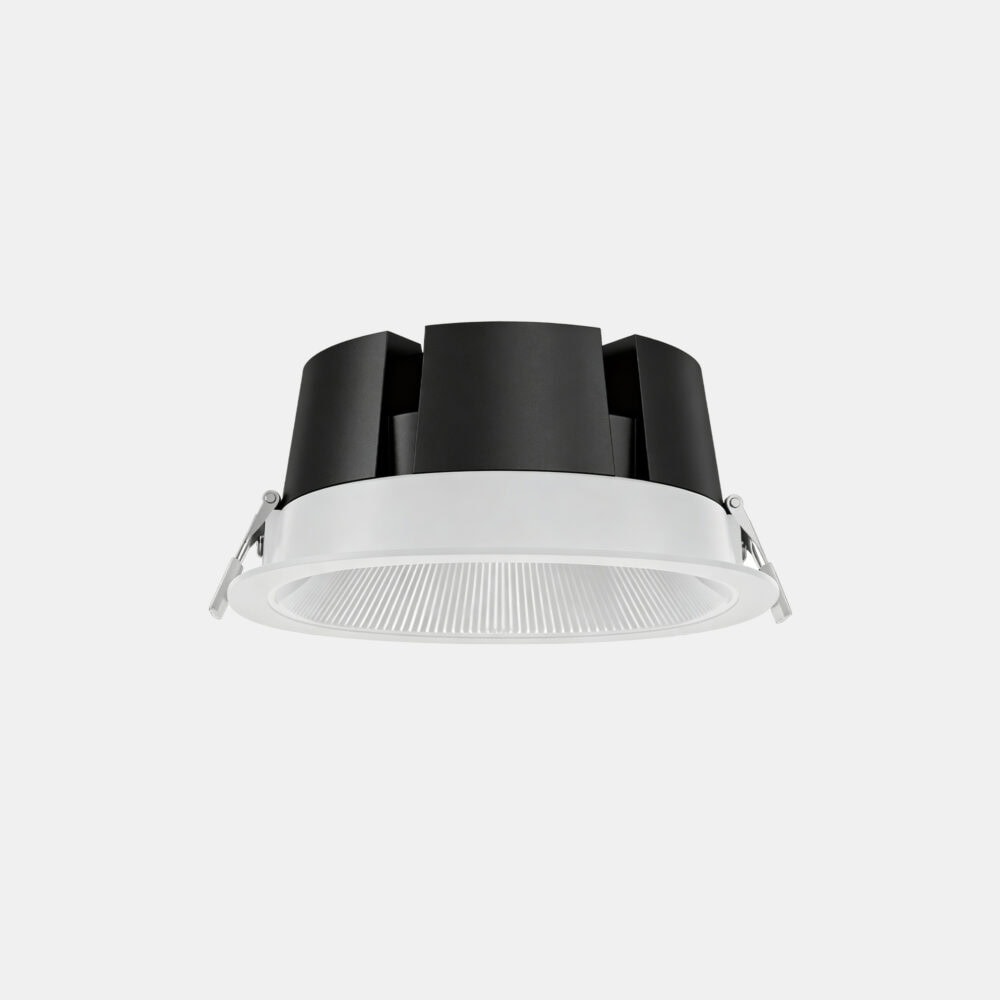
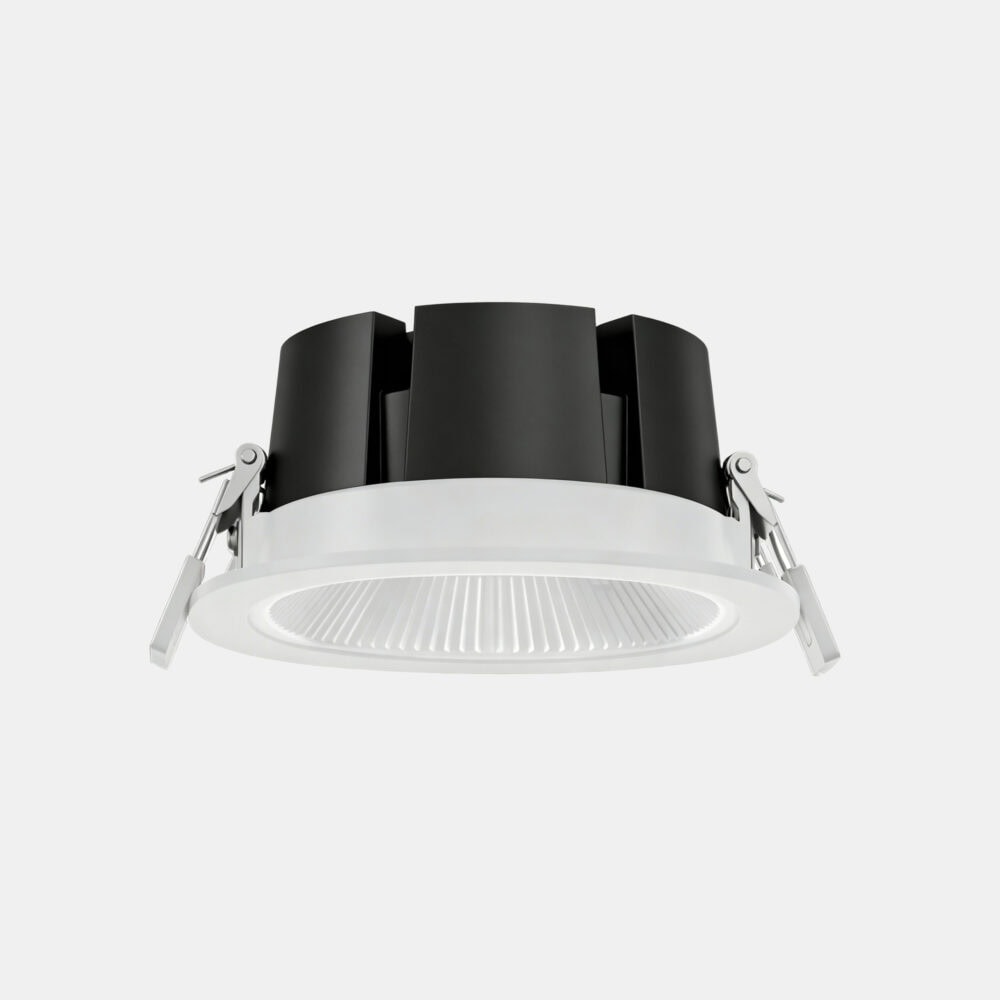
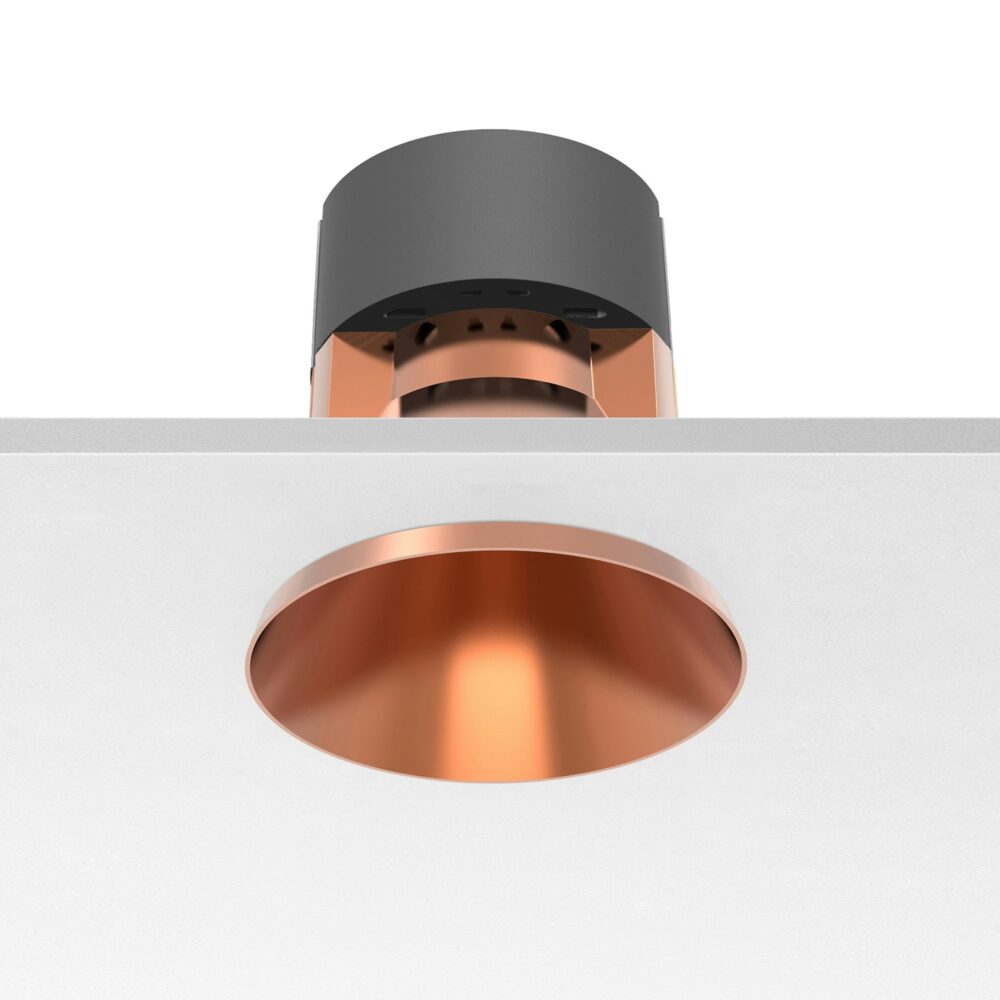
Downlights and spotlights do the unglamorous work in a building: circulation, back of house, wet areas, retail display and the general layer under a decorative scheme. They are also where most lighting complaints originate, because a fitting that is cheap to buy is expensive to live with if the beam, the colour or the glare control is wrong.
Beam angle decides the effect
A narrow beam concentrates light and creates shadow contrast; a wide beam flattens a surface. In practice: 15 to 24 degrees for accent on artwork, retail display and reception signage; 36 degrees as the general-purpose default for corridors and guestroom perimeters; 60 degrees and above for wall washing and for low ceilings where a narrow beam would punch a bright circle on the floor.
The beam also sets spacing. Spacing roughly equals the mounting height multiplied by the tangent of half the beam angle, doubled. A 36 degree fitting at 2.7 m covers about 1.75 m of floor, so spacing beyond that leaves dark bands between pools.
Cutout and ceiling depth
Cutout diameter is fixed by the ceiling, not by preference: a 75 mm hole cannot take a 90 mm body. Depth matters as much. Insulated ceilings, concrete soffits and acoustic rafts all reduce the space behind the plaster, and a fitting that needs 120 mm of clearance will not fit into a 90 mm void without a surface-mounted alternative.
Colour quality and glare
For guestrooms and dining, 2700 K to 3000 K at CRI 90 or above; for back of house and car parks, 4000 K at CRI 80 is enough. Glare control is specified as UGR: keep it at or below 19 where people sit and read, 22 in dining, 25 in circulation. Deep-recessed and baffled designs achieve this without a visible bright source, which matters in a lobby where guests look up.
IP ratings by room
Bathroom zones are set by IEC 60529: IPX7 inside the tray, IP44 as a minimum in zones 1 and 2, and IP65 where a fitting sits low or faces a shower head. Exterior soffits and canopies need IP65 and a corrosion-resistant body, not just a gasket.
Dimming and control
Mains dimming (TRIAC) is the cheapest and the least reliable at low output; 0-10V and DALI-2 hold output down to 1 to 5 percent without flicker. If the specification calls for scene setting or daylight linking, decide the protocol before the driver is ordered, because it cannot be changed on site.
How many fittings
Work back from the target illuminance rather than from a rule of thumb. A 100 lux corridor at 2.7 m typically needs one 8 W to 12 W fitting every 2.5 m to 3 m. A 300 lux retail display needs roughly twice that density, and vertical illuminance on the product, not the floor, is the number that decides the merchandising result.