Most IP charts tell you what the standard says. This IP rating chart tells you what to write in a specification, which is a different job. A table row that reads “IP44 — protected against splashing water” leaves a supplier free to test only the lens. The chart below pairs each rating with its test conditions, the hotel locations where it belongs, and the sentence that closes the loophole. Everything below can be lifted straight into a tender document. Numbers are from IEC 60529; the applications come from tender documents and site failures.
1. How to read the chart
Read the two digits separately. The first covers solids, 0 to 6, and the second covers water, 0 to 8. IP65 means dust tight and jet resistant; it does not mean “more waterproof than IP44” in every situation, because the two were tested on different rigs.

Three conventions trip people up. An X means untested, not failed. A rating applies to the complete luminaire as tested — cable gland, driver, diffuser, gasket — not to the lens alone. And the rating is a type test: it proves the design can pass, not that every unit did. That last point is why the wording in section 7 matters as much as the number.
| Rating | Solids | Water | Typical hotel use |
|---|---|---|---|
| IP20 | None tested | None tested | Guestroom ceiling, corridor, ballroom |
| IP21 | ≥ 12.5 mm | Gouttes d’eau tombant verticalement | Under a dry ceiling with occasional drips |
| IP23 | ≥ 12.5 mm | Spray at 60° | Canopy soffit, sheltered walkway |
| IP44 | ≥ 1.0 mm | Splash, 360° | Bathroom zone 1 and 2, covered balcony |
| IP54 | Dust protected | Splash, 360° | Sous-face du parking, couloir de service |
| IP55 | Dust protected | Jet, 6.3 mm | Kitchen back of house, plant room |
| IP65 | Étanche à la poussière | Jet, 6.3 mm | Exposed terrace, pool deck, façade |
| IP66 | Étanche à la poussière | Powerful jet, 12.5 mm | Washdown wall, commercial kitchen |
| IP67 | Étanche à la poussière | Immersion à 1 m pendant 30 min | Water feature, step light in a basin |
| IP68 | Étanche à la poussière | Immersion, depth by agreement | Pool niche, fountain nozzle |
2. IP20-IP23: dry interiors
IP20 is the correct answer for most of a hotel. Guestrooms, corridors, lobbies, ballrooms and restaurants are dry ceilings, and adding a gasket there buys nothing except a hotter driver. The failure mode in these spaces is dust from construction and renovation, which settles on the lens and is cleaned, not water.
IP21 and IP23 exist for the edges. IP21 tolerates vertical drips, which is what a poorly insulated concrete soffit delivers in a humid climate for a few weeks after handover. IP23 adds spray at 60° from vertical, and it fits the underside of an external canopy: rain does not fall upward, but wind pushes it in at an angle.
Do not stretch IP20 into a semi-external position because the ceiling “looks dry”. An open-sided lobby in a monsoon climate is not a dry ceiling. The first monsoon finds the joint between the ceiling rose and the plaster, and the fitting fills.
3. IP44: bathrooms and covered terraces
IP44 is the most specified rating in the hotel sector and the most often misapplied. The test is 1 mm solids plus splashing water from any direction at 10 litres per minute for five minutes. That is a splash, not a jet, and it is the basis of the zone 1 and zone 2 minimum in IEC 60364-7-701.
It suits a guestroom bathroom, a vanity light beside a basin, and a balcony with a roof over it. It does not suit a public bathroom where housekeeping uses a hose, and it does not suit a shower that can be aimed at the fitting. For those, move to IP65 and check the shock protection separately.
| Test | Nozzle | Flow | Duration | Distance |
|---|---|---|---|---|
| IPX4 splash | Oscillating shield | 10 L/min | 5 min | 0.3–0.5 m |
| IPX5 jet | 6.3 mm | 12.5 L/min | 3 min | 3 m |
| IPX6 powerful jet | 12.5 mm | 100 L/min | 3 min | 3 m |
| IPX7 immersion | — | Static head | 30 min | 1 m depth |
The flow figures explain most arguments on site. A housekeeping hose delivers roughly 8–12 litres per minute at close range. That is IPX5 territory, not IPX4, and the distance is a metre rather than three. A fitting that passed IPX4 at 0.3 m will be tested under conditions it never met in the field.
Covered terraces are a judgement call rather than a rule. The determining factor is not whether there is a roof, but whether rain can reach the fitting at an angle of more than about 60° from vertical. A 2 m deep loggia with a solid soffit stays at IP44. A 600 mm balcony overhang on a windy coast behaves like open sky, and the fittings there will corrode and fill regardless of what the drawing says.
4. IP54-IP55: dusty and damp areas
IP54 and IP55 add the solid digit that IP44 lacks, and this is where car parks, service corridors and back-of-house belong. At IP5X the enclosure limits dust entry but does not stop it; dust can still reach the interior, and on an LED board that means gradual lumen depreciation and a dirty diffuser that cannot be cleaned.
Choose IP54 for a soffit over a covered car park, and IP55 where a hose is used. Plant rooms and kitchen back-of-house typically sit at IP55, and the fitting should be rated for the ambient temperature as well — a plant room at 40 °C cuts driver life substantially compared with a 25 °C corridor.
Dust protection has a second benefit that rarely gets mentioned: it keeps insects out. In warm climates an IP20 ceiling fitting in a lobby becomes an insect trap within a season, and the labour to clean it costs more than the IP54 premium.
5. IP65-IP66: jets and washdown
IP65 is the practical outdoor baseline: dust tight, and resistant to a 6.3 mm jet at 12.5 litres per minute from 3 m for three minutes. Terraces, pool surrounds, garden path lights, façade uplights and porte-cochère soffits all sit here.
IP66 uses a 12.5 mm nozzle at 100 litres per minute — eight times the flow — and it is the rating for surfaces that get washed. A commercial kitchen wall, a refuse area, a loading dock and a pool plant room are IP66 spaces. The difference in construction is usually the gasket compression and the cable entry, not the housing material.
One caution on IP65 outdoors: the test does not include UV, salt or thermal cycling. A fitting can pass IPX5 in a laboratory and fail in eighteen months on a beachfront because the gasket hardened. Rating and material have to be specified together, which is the point of the coastal guide rather than this chart.
6. IP67-IP68: immersion and pools
IP67 is 1 m of static water for 30 minutes. IP68 is deeper or longer, with the depth and duration agreed between buyer and maker, so an IP68 claim without those two numbers cannot be verified and should be rejected at submittal.
Pool niche lights are the main application, along with fountain nozzles, step lights set into a water feature, and uplights in a reflecting pool. Three details decide whether the rating holds in service. The cable tail must be long enough to reach a dry junction box. The connector must be rated for the same environment as the fitting, because a potted IP68 body with an IP44 connector is an IP44 installation. And the fixing must be 316 stainless, or the bracket will fail before the seal does.
For a pool, IEC 60364-7-702 governs the electrical installation and requires SELV or equivalent protection in the water zone. The IP rating covers water ingress; it does not cover touch voltage.
Step lights in a water feature deserve their own line because they sit in the worst position on the whole chart. They are immersed, they are kicked, and their cable route runs upward through wet stone. Specify IP68 with a stated depth, IK08, 316L stainless trim, and a cable tail long enough to reach a dry gland above the waterline. If any of those four is missing, the fitting will be replaced within two seasons.
For exposed terraces and façades, the architectural lighting solutions overview sets out how we handle drainage, cable routing and fixing detail at design stage, which is cheaper than resolving it after the waterproofing is closed.
7. Specification wording that holds
The chart only works if the specification borrows its precision. These are the sentences I use, and each one exists because a supplier found a gap in a looser version.
| Weak wording | Wording that holds |
|---|---|
| Suitable for bathroom use | IPX4 minimum to IEC 60529, tested as a complete luminaire with cable gland fitted; suitable for zone 1 per IEC 60364-7-701 |
| Outdoor rated | IP65 to IEC 60529, corrosion class C4 to ISO 9223, UV-stabilised diffuser, 316 stainless fixings |
| Waterproof | IPX7, immersion 1 m for 30 min, test report to be submitted with the sample |
| Dust proof | IP6X, dust tight, first digit 6 tested and stated in the report |
| IP65 equivalent | Delete the phrase; require the test report for the exact model offered |
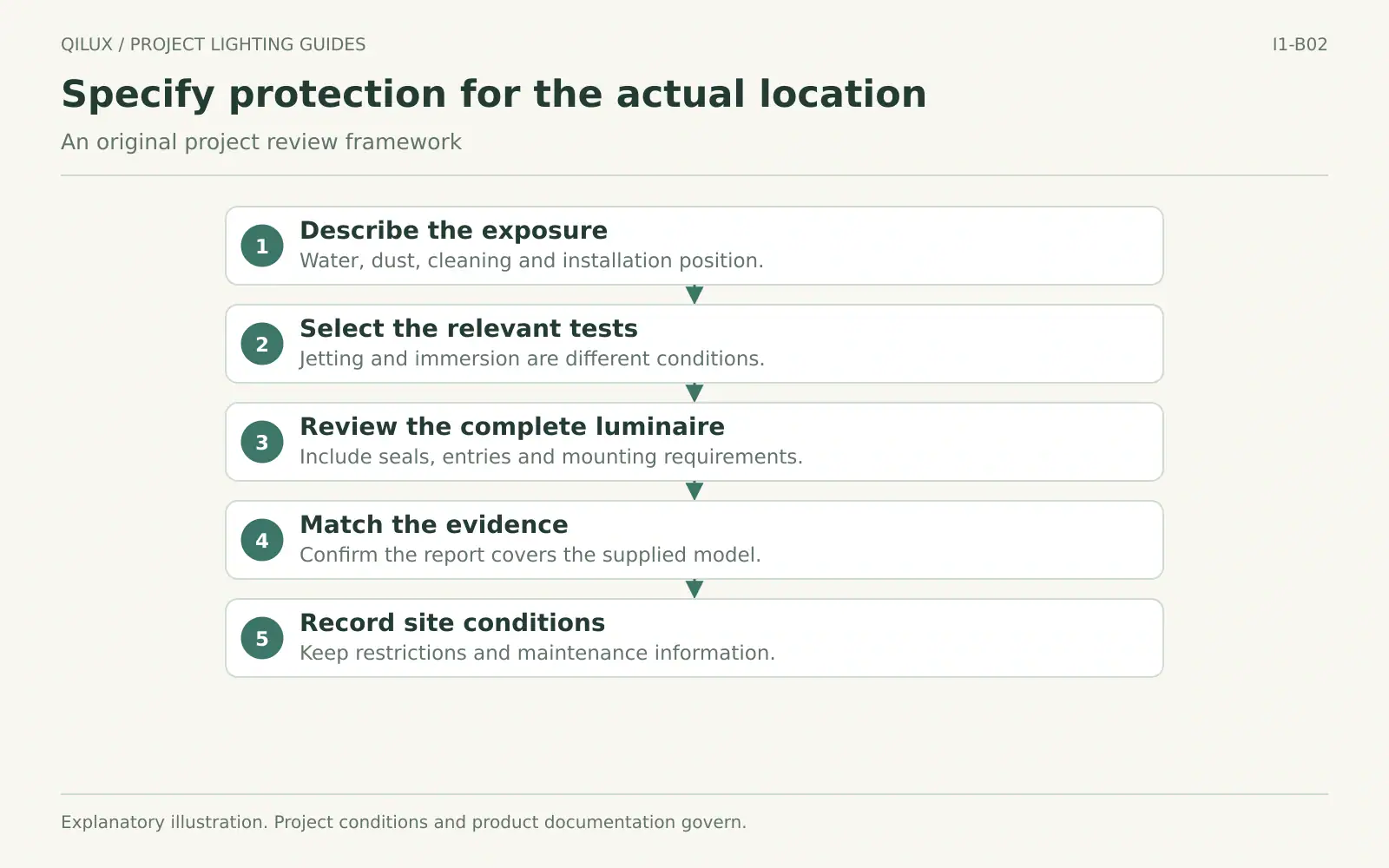
Two more clauses are worth the ink. Require the IP test report for the specific variant supplied, not the family. And require that the driver, gasket and cable entry shown in the report match the delivered product; a report tested with a blanking plate is not evidence for a fitting with a gland.
Finally, put the IP in the schedule rather than in the notes. Items in a notes column get value-engineered out at tender stage; items in a schedule column with a model number do not.
Foire aux questions
What is the difference between IP44 and IPX4?
IP44 means both digits were tested: 1 mm solids and splashing water. IPX4 means only the water test was carried out, and the solid digit is untested. For a bathroom either can be compliant, but in a dusty ceiling void IP44 is the safer specification.
Is IP65 suitable for a bathroom?
IP65 exceeds the IPX4 requirement for zones 1 and 2, so water ingress is covered. What it does not cover is shock protection, ambient temperature or the salt and chlorine in the air. A pool-side bathroom needs a corrosion-resistant finish as well as the rating.
Can I use IP20 downlights in a bathroom?
Not within zones 0, 1 or 2. Outside the zone boundaries — typically beyond 0.6 m from the bath or shower — an IP20 fitting is permitted if the manufacturer allows it, but most specifiers keep IP44 across the whole room because cleaning practice is hard to control.
Does IP68 mean it can go in a swimming pool?
Only if the datasheet states the depth and duration it was tested to, and only if the cable tail, connector and fixing are rated for the same conditions. IP68 is a maker-defined rating, so the numbers on the datasheet are the specification.
Why do two IP65 fittings perform differently outdoors?
Because IP65 does not test UV, salt or thermal cycling. Differences in gasket material, powder coat chemistry and stainless grade decide the service life. Silicone gaskets and 316 stainless outlast EPDM and plated steel by a wide margin on a coastal site.
Étape suivante
The chart is also available as a one-page PDF for tender packs, with the test conditions and the specification clauses in the same layout. Request it through our capabilities and documentation page, which also lists the test reports we hold for wet-area and exterior families. If the project is already at submittal stage, the bathroom and wet-area range shows which rating each family carries, and the zone logic behind it is explained in bathroom lighting zones. For the reasoning behind the digits rather than the table, start with le guide complet sur l’indice IP.