Linear Light 001 — LL001
View fixture ↗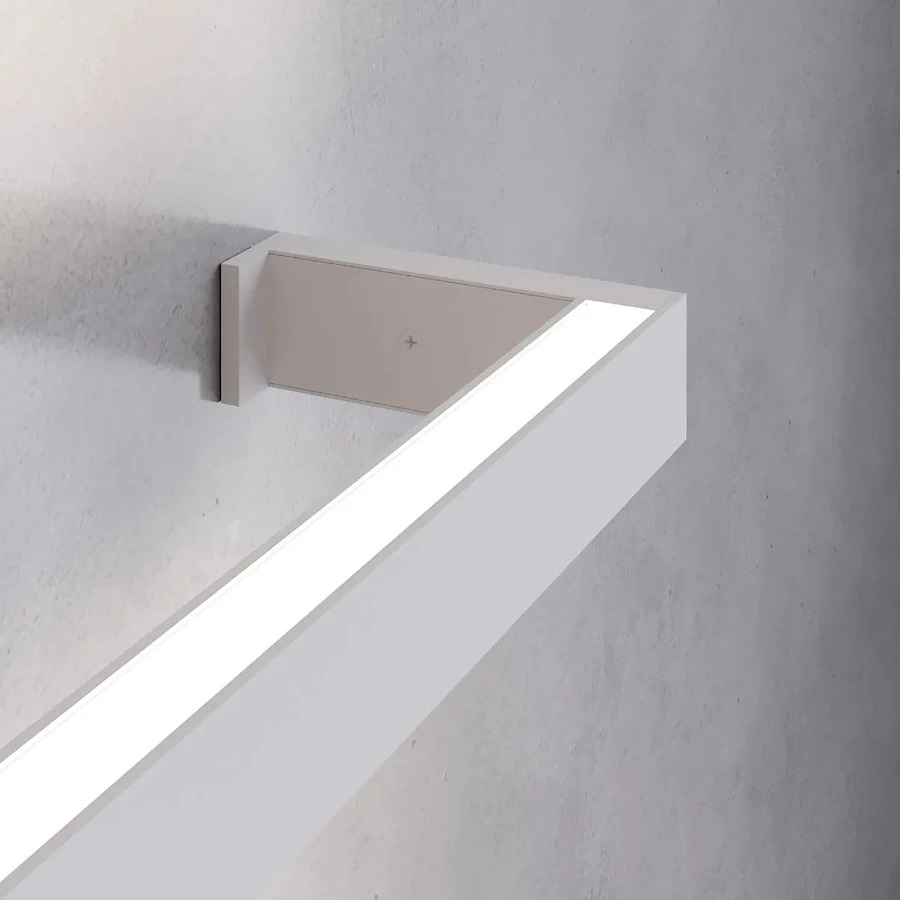
Linear Light 002 — LSL002
View fixture ↗Need a different size or finish?
Any model can be adapted for a project brief — dimensions, materials, finishes and light colour.

Any model can be adapted for a project brief — dimensions, materials, finishes and light colour.
Linear and profile lighting is the quietest tool in the kit: it produces an even line of light with no visible source, which is why it appears in almost every high-end interior and almost never in the photograph. It is specified for coves, wall grazing, suspended runs over counters and stair nosings.
Cove and indirect. The profile sits inside a ceiling recess and throws light onto the soffit. Output is halved by the bounce, so the run needs roughly twice the lumens of a direct solution for the same effect, and the recess geometry matters more than the fitting.
Wall grazing and washing. Mounted 0.3 m to 0.5 m from the wall, the run reveals texture in stone and plaster. The closer the profile, the tighter the scallop; spacing of adjacent runs at 0.8 to 1.0 times the offset keeps the wash even.
Suspended linear. Hung over a bar, a communal table or a reception desk, it defines the zone without a pendant in the sightline. Suspension height follows the pendant rule: 75 cm to 90 cm above a table surface.
A long line is only convincing if the joins disappear. Specify the profile with a diffuser that sits flush, order the sections as a set with matched LED bins, and plan the feed point at one end rather than the middle. Connectors introduce a shadow; where a run must be broken, put the break at a structural line in the ceiling.
Linear output is quoted per metre, which makes comparisons easy but hides the driver. A 15 W/m run at 120 lm/W gives about 1800 lm per metre before the diffuser, and a diffuser costs 15 to 30 percent of that. For a 300 lux workspace, a single row over a 1.2 m desk depth is usually enough; for a cove, work from the reflected output and expect two to three times the nominal length.
Right-angle and radius corners are made, not bent on site, so the drawing needs to specify the radius. Stair nosings and step lighting use the same family at low output, and the IP rating rises to IP65 where the profile meets the floor.
Outside, the profile is the weak point, not the LED. Look for anodised aluminium with a gasketed diffuser, IP65 or better, and a drain path so that condensation cannot pool behind the strip.