

IP and IK are both two-digit codes stamped on a luminaire, and they are routinely confused in specifications. IP is IEC 60529: does water or dust get in. IK is IEC 62262: does the housing survive being hit. A fitting can be IP66 and IK04, which is fine on a ceiling and useless at knee height beside a luggage trolley. Both numbers belong in a schedule, and they answer questions that never overlap. One of them is also frequently copied from the other by mistake, which is how a fitting ends up specified three times tougher than it is.
1. Two ratings, two failure modes
The failures look different on site. An IP failure is progressive: water enters, the driver corrodes, the fitting flickers and then dies. An IK failure is immediate: a cracked diffuser, a dented body, sometimes a shattered lens on the floor after one impact.
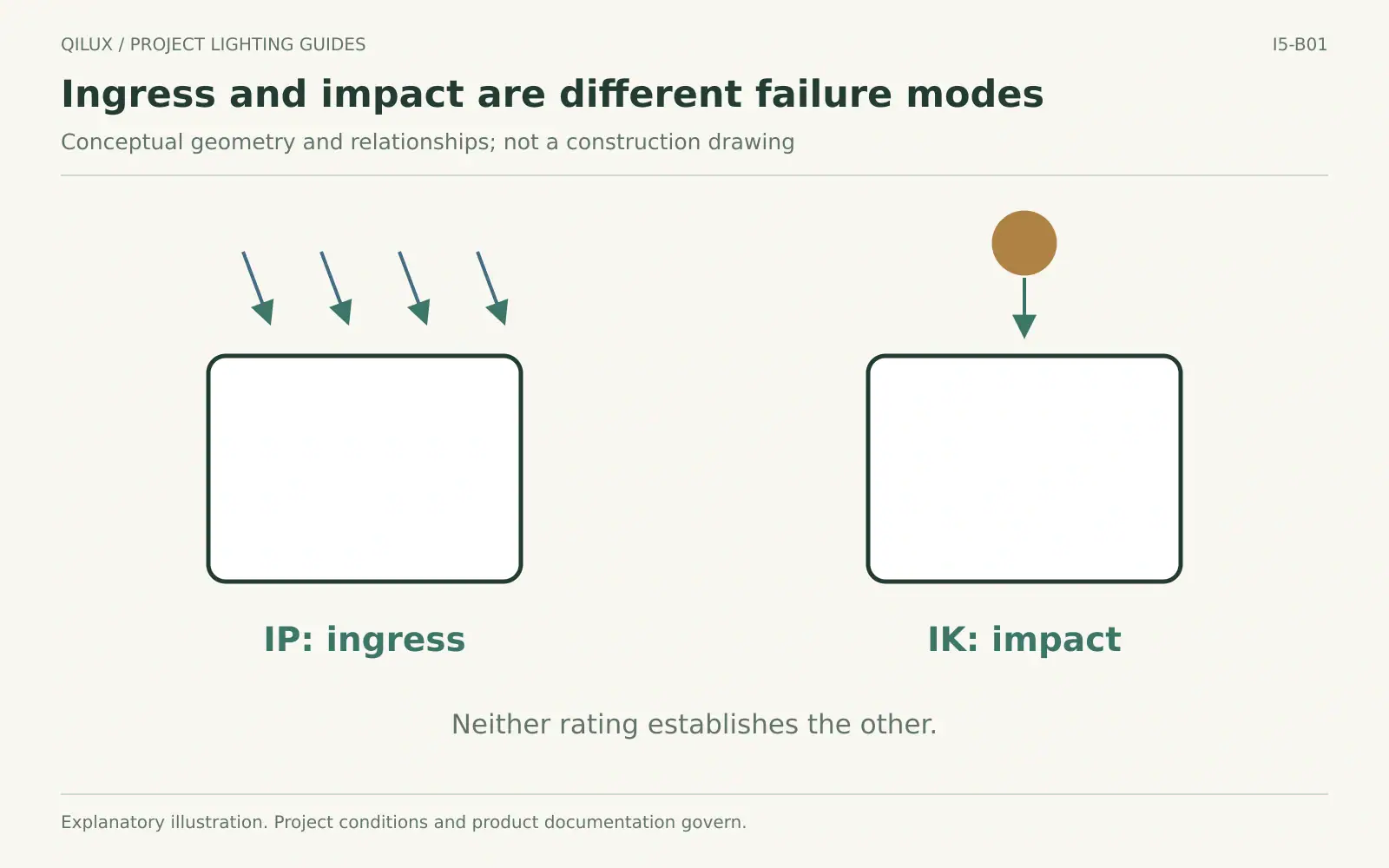
IP has been covered thoroughly elsewhere, so the short version: the first digit is solids 0–6, the second is water 0–8, and the rating applies to the complete luminaire as tested. IK has a single digit from 00 to 10, and it measures the impact energy an enclosure withstands without compromising its protection.
The important subtlety is that IK is not an independent property. Once the housing is dented or the gasket seat is deformed, the IP rating is gone. An impact that leaves a fitting working but out of shape will let water in for the rest of its life. That is why exterior and public-area specifications need both numbers rather than the higher of the two.
2. How IK testing works
IK is tested with a striker — a pendulum hammer for smaller values or a free-fall hammer for larger ones — dropped or swung onto the specimen at defined points, usually five impacts. The energy is set by the mass and the drop height, and the test reports the highest energy survived without damage that would impair protection.
Two conditions are worth knowing because they explain field failures. The test is carried out at the ambient temperature of the laboratory, and polymers behave very differently at 0 °C or at 50 °C in sun. A polycarbonate diffuser rated IK08 at 23 °C can crack at 5 °C in a winter installation. And the test strikes the weakest accessible point, not the strongest one, so a rating quoted for a body says little about the lens if the lens was masked during testing.
| IK | Impact energy | Rough equivalent |
|---|---|---|
| IK00 | Koruma yok | — |
| IK01 | 0.14 J | A light knock |
| IK02 | 0.20 J | Hand contact, hard |
| IK03 | 0.35 J | A tool dropped from 100 mm |
| IK04 | 0.50 J | A 0.5 kg object from 100 mm |
| IK05 | 0.70 J | A 0.7 kg object from 100 mm |
| IK06 | 1.0 J | A 1 kg object from 100 mm |
| IK07 | 2.0 J | A 1 kg object from 200 mm |
| IK08 | 5.0 J | A 1.7 kg object from 300 mm |
| IK09 | 10.0 J | A 5 kg object from 200 mm |
| IK10 | 20.0 J | A 5 kg object from 400 mm |
The jump from IK08 to IK09 is double the energy, and IK09 to IK10 is double again. That is why IK10 fittings are markedly heavier and more expensive: the wall thickness and lens material have to change, not just the gasket.
3. IK08 vs IK10 in real installations
IK08 at 5 J is the sensible default for anything a person or a trolley can reach. It survives a shoulder bag, a cleaning bucket, a luggage cart wheel and most accidental contact with a maintenance ladder. For hotel corridors, guestroom wall lights, path lights and terrace fittings, IK08 is the number to write.
IK10 at 20 J is vandal resistance in the literal sense: a deliberate blow with a hammer or a bottle. It belongs in public toilets, transport interchanges, sports facilities, car parks and any unsupervised area where fittings get kicked. A polycarbonate lens on a die-cast body is typical; a glass lens rarely reaches IK10 without a sacrificial shield.
The trade-offs are real. An IK10 body is heavier, which changes the fixing detail — a wall light that needs four M6 anchors instead of two is a different installation cost. A thick polycarbonate lens absorbs light and yellows under UV, so an IK10 fitting outdoors may deliver 8–10% less light after five years than an IK08 fitting with a glass lens. For a beachfront resort, that trade can be the wrong way round, and IK08 with a tempered glass diffuser is often the better answer.
One more distinction: IK is not a load rating. A recessed deck light that people walk on needs a static load figure in newtons, tested separately, and an IK10 rating says nothing about whether it will survive a heel in a stiletto.
The lens material decides most of it. Tempered glass at 4–5 mm reaches IK08 comfortably and holds its transmission for a decade. Laminated glass adds a plastic interlayer that holds fragments in place after a break, which matters in a public area and costs roughly 15% more. Polycarbonate reaches IK10 easily but scratches, yellows and needs a UV-stable grade; it is the right choice where vandalism is expected and the wrong one where light quality matters. Acrylic sits between the two, with better clarity than polycarbonate and worse impact performance.
4. Where impact matters in hotels
The exposure is predictable once you map it against height and traffic. Two zones cover almost everything.
Knee to shoulder height, in circulation areas. Corridor wall lights, lift lobby fittings, restaurant wall washers at booth height, path lights and bollards. Trolleys, luggage and cleaning machines all travel at this height, and this is where IK08 is the minimum and IK10 is common in back-of-house corridors.
Floor level, in public and semi-public areas. Step lights, deck lights, uplights at the base of a wall, floor washers in a lobby. These take feet, cases and dragged furniture. Specify IK08 for a hotel and IK10 for a public building, and always check the load rating separately if the surface is walked on.
Three positions are usually under-specified. Guest bathroom fittings below 1.2 m, where a hairdryer or a cleaning cart hits the mirror light. Pool deck fittings, where a wet floor plus a trolley is the worst combination. And service corridor fittings, where cages and laundry carts are pushed against the wall daily.
Above 2.4 m, impact is rarely a design driver except in sports halls and atriums where balls or maintenance access come into play. That is the one place where spending on IK is usually wasted, and the money is better spent on the IP and the finish.
5. Specifying IP and IK together
Write both numbers against the location, in the schedule, with the material that delivers them. A single sentence per row is enough: “IP65, IK08, die-cast aluminium body, 4 mm tempered glass, A4 fixings.”

| Konum | IP | IK | Not |
|---|---|---|---|
| Guestroom ceiling, corridor ceiling | IP20 | Gerekli değil | Out of reach |
| Guestroom wall light | IP20–IP44 | IK07–IK08 | Below 1.2 m, cleaning contact |
| Bathroom mirror light | IP44 | IK07 | Hairdryer and cart contact |
| Corridor wall light, back of house | IP20–IP54 | IK10 | Trolley traffic |
| Terrace and path light | IP65 | IK08 | Trolleys, cases |
| Pool deck, step light | IP67 | IK08–IK10 | Wet floor plus trolley |
| Car park, service area | IP54–IP65 | IK10 | Vehicles, vandalism |
| Public toilet, transport area | IP44–IP65 | IK10 | Deliberate damage |
Installation damage deserves its own line. A fitting rated IK08 can be destroyed during commissioning by an impact driver set too high, or by a ladder placed against a wall light. On projects with a high fit-out turnover, specify a protective film on the lens until handover, and ask the contractor to record any fitting that was struck during installation. The damage rarely shows as a crack; it shows as a hairline in the diffuser that opens in the first cold snap.
Three clauses close the gaps that a bare number leaves open. Require the IK report for the exact model, with the lens in place and unmasked. Require the test temperature, or at least confirm the material is rated for the site’s low temperature. And require that the IP report and the IK report cover the same configuration, because a common trick is to submit an IK report for the body and an IP report for a different variant.
On a coastal site, add the corrosion class to the same row. IP and IK can both be satisfied by a fitting that dissolves at the fixings, and the material column is what prevents it — the arguments are set out in the coastal lighting guide.
Finally, check the interaction at design stage rather than at commissioning. An IK10 lens is thicker, absorbs more light and runs hotter; if the fitting is also sealed to IP65, the driver may be running 10 K above its rated condition. Ask for the lumen output and the driver case temperature in the proposed configuration, not only the catalogue headline figures.
Next step
For public areas, back-of-house corridors and exterior circulation, impact resistance is as much a maintenance decision as a security one. Our public space lighting solutions set out the IP and IK pairing we use per location, and the capabilities page lists the impact and ingress reports available for each family. If the project has a mix of guest, public and service areas, send the schedule through the commercial project desk and it will come back with both ratings specified per row, plus the fixing detail that makes them hold.