

Tunable white lighting lets one fixture deliver any colour temperature between about 2700 K and 6500 K, usually by mixing two or three LED channels under one diffuser. It replaces the fixed decision “which CCT for this room” with a scene that can change through the day: 3500 K at breakfast, 2700 K at dinner, 2200 K at turndown. It is worth the control infrastructure in lobbies, restaurants, spas and meeting rooms, and rarely worth it in a guestroom corridor where nobody changes a scene.
1. What tunable white can and cannot do
The mechanism is simple. Two LED channels, one warm (typically 2700 K) and one cool (5000–6500 K), are driven at variable ratios by a driver that reads a control signal. Mix three and the mid-range stays cleaner. The output CCT is the blended result, and the total lumen output can be held constant while the ratio changes.
What it can do: match the light to the time of day, support a circadian story where the operator wants one, let a single space serve breakfast and dinner, and keep a lobby consistent as daylight fades through the glazing. It also lets a designer hedge — specify 3000 K nominally, then tune to the finishes on site during commissioning without changing fixtures.
What it cannot do: fix a bad spectrum, replace dimming, or improve colour rendering. Tunable white controls the white point, not the fidelity. A two-channel mix at 3000 K can easily score R9 lower than a dedicated 3000 K fixture, because the blend crosses a region where both channels contribute partially. That is the single most common surprise on these projects.
It also cannot compensate for a cheap driver. The CCT range is a property of the LED channels; the smoothness of the transition, the absence of flicker at low output and the stability of the CCT under dimming are properties of the driver.
2. CCT ranges and CRI across the range
Most architectural tunable white product spans 2700 K to 6500 K. Hospitality usually needs a narrower band: 2200 K to 4000 K covers every scene a hotel actually uses, and the narrower the band, the better the spectrum at the endpoints, because each channel is closer to its native output.
| Range | 一般的な用途 | CRI at endpoints | Practical note |
|---|---|---|---|
| 2200–4000 K | Hotel guestrooms, restaurants, bars, spa | Ra ≥ 90、R9 ≥ 50 | Best spectrum; matches dim-to-warm behaviour at the low end |
| 2700–5000 K | Lobbies, meeting rooms, retail | Ra ≥ 90 at 2700–4000 K, drops toward 5000 K | Common stock range; check CRI at 5000 K |
| 2700–6500 K | Healthcare, offices, demonstration spaces | Ra ≥ 85 at the cool end | Widest range, weakest endpoints; rarely needed in hospitality |
| 1800–3000 K | Bars, evening dining, boutique guestrooms | Ra ≥ 90 | Effectively dim-to-warm with a setpoint |
The CRI claim needs qualifying, and suppliers rarely do it. A tunable fixture’s CRI is not one number; it changes with the mix. At the warm endpoint the cool channel contributes little, so the CRI approaches that of the warm channel alone. In the middle of the range both channels run at partial output and the combined spectrum can have a dip where the two peaks fail to overlap — typically around 480–500 nm.
Require the CRI to be reported at three points across the range, not one. A workable clause is Ra ≥ 90 and R9 ≥ 50 at 2700 K, 3500 K and 4000 K, measured on the complete luminaire. Fixtures that pass only at the endpoints should be rejected.
Also check the lumen maintenance across the range. A fixture that delivers 1,000 lm at 4000 K and 700 lm at 2700 K will visibly dim as the scene warms, which is sometimes desirable and sometimes a complaint. If constant output is required, that has to be specified as a driver function.
3. DALI DT8, DMX and wireless control
Tunable white needs a control channel that can carry a colour temperature value, not just a dimming level. Four options dominate.
| プロトコル | How CCT is carried | 一般的な調光範囲 | Best for |
|---|---|---|---|
| DALI-2 DT8 | Tc (colour temperature) command, 1 K resolution | 0.1–1% | Hotels, restaurants, scene-based spaces |
| DMX512 | Separate channel per LED bank | 0.1% | Bars, facades, dynamic and theatrical |
| Casambi / Zigbee / BLE | App or gateway sets the mix | 1% | Retrofit, listed buildings, no new cabling |
| 0–10 V twin channel | Two analogue signals, warm and cool | 1–5% | Budget schemes, simple scenes |
DALI-2 DT8 is the right default for hospitality. It carries a real Tc value rather than a ratio, so a scene recall produces the same colour on every fixture regardless of the channel mix, and it supports 64 addresses per line with scene memory in the driver. Certification matters: a driver claiming DALI-2 should appear in the DiiA product database, and DT8 device type 8 is the specific part that handles colour temperature.
DMX is the right answer when the lighting is part of a show — a bar with a colour sequence, a facade, a ballroom that changes temperature between events. It is heavier to commission and less friendly to facilities teams, so keep it out of guestroom areas.
Wireless is the pragmatic answer for retrofits where pulling a bus cable is not viable. The trade-off is battery-free switches and gateway dependency: if the gateway fails, the room reverts to its default. For a hotel that means a documented fallback scene, tested.
The control design questions that matter more than the protocol: how many scenes, who can edit them, what happens on power restoration, and whether the BMS can override. Those are covered in dimming and switching for hotel lighting.
4. Scenes: breakfast, lunch, dinner, turndown
Scene design is where tunable white earns its keep or becomes an unused feature. The rule is few scenes, clearly named, with a real difference between them. Four is usually right for a restaurant, three for a lobby.

| Scene | 色温度 | Level | Intent |
|---|---|---|---|
| Breakfast | 3500~4000 K | 200–300 lx | Alert, clean, supports early tasks |
| Lunch | 3000–3500 K | 200 lx | Neutral, food still reads accurately |
| Dinner | 2700 K | 150–200 lx ambient, 300 lx table | Warm, intimate, skin flattering |
| Turndown | 2200–2400 K | 50–80 lx | Low, amber, signals end of day |
| Cleaning / reset | 4000 K | 300 lx | Staff use; hidden from guest controls |
The details that separate a working scheme from an annoying one are the transition and the level compensation. First, the transition: an instant jump from 3500 K to 2700 K at 7 pm is visible and reads as a fault. Fade over 10–20 minutes, or trigger the change at a time when the room is empty. Second, the level compensation: as CCT drops, perceived brightness drops with it, so a dinner scene at the same dimming level as lunch will feel darker than intended. Program the level and the CCT together.
In guestrooms, keep it simple. A single “evening” scene at 2400–2700 K and a “morning” scene at 3000–3500 K is enough; guests do not want to program a colour temperature before bed. Put the scene on a bedside keypad with two buttons, and make the default warm.
For the CCT relationships behind these numbers, see 2700 Kと3000 Kの比較 and 3000 K versus 4000 K.
5. Cost and commissioning overhead
Tunable white costs more in three places, and the third is the one that catches projects out.
The fixtures cost more: two or three LED channels, a more complex board, tighter binning to keep the blend clean, and a driver that supports Tc. The control system costs more: a DALI-2 DT8 bus, controllers, gateways, keypads, and often a lighting control supplier who is not the fixture supplier.
Commissioning costs more, and this is where budgets fail. Every fixture needs its address set, its scene membership assigned, and its output verified at three CCTs. On a 400-fixture restaurant and lobby package that is several days of two people on site, plus a return visit after the client has lived with the scenes for a month. Budget it as a line item, not as part of “lighting installation”.
| Cost element | What drives it | Where it surprises |
|---|---|---|
| 器具 | Channel count, binning, driver type | Narrow-band tunable costs more than wide-band |
| Control hardware | Bus, controllers, keypads, gateways | Gateway and app licences are often excluded |
| Commissioning | Fixture count × scenes × CCT points | Second visit after handover is usually needed |
| Spares | Channel-matched spares, same batch | Mismatched spares are visible at scene changes |
There are cheaper routes to the same effect. Limit tunable white to the fixtures that define the room — the cove, the feature pendants, the wall wash — and leave the general downlights fixed at 3000 K. Or run the whole scheme at one CCT and use dimming plus a warm layer for the evening scene, which gets most of the visual benefit for a fraction of the control scope.
6. When dim-to-warm is enough
Dim-to-warm is the single-axis version: one fixture that shifts from, say, 3000 K at full output down to 1800–2200 K as it dims. It needs no colour channel, no DT8, and no scene programming beyond the dimmer. For a restaurant, a bar or a guestroom, it delivers the amber evening look that guests actually notice.
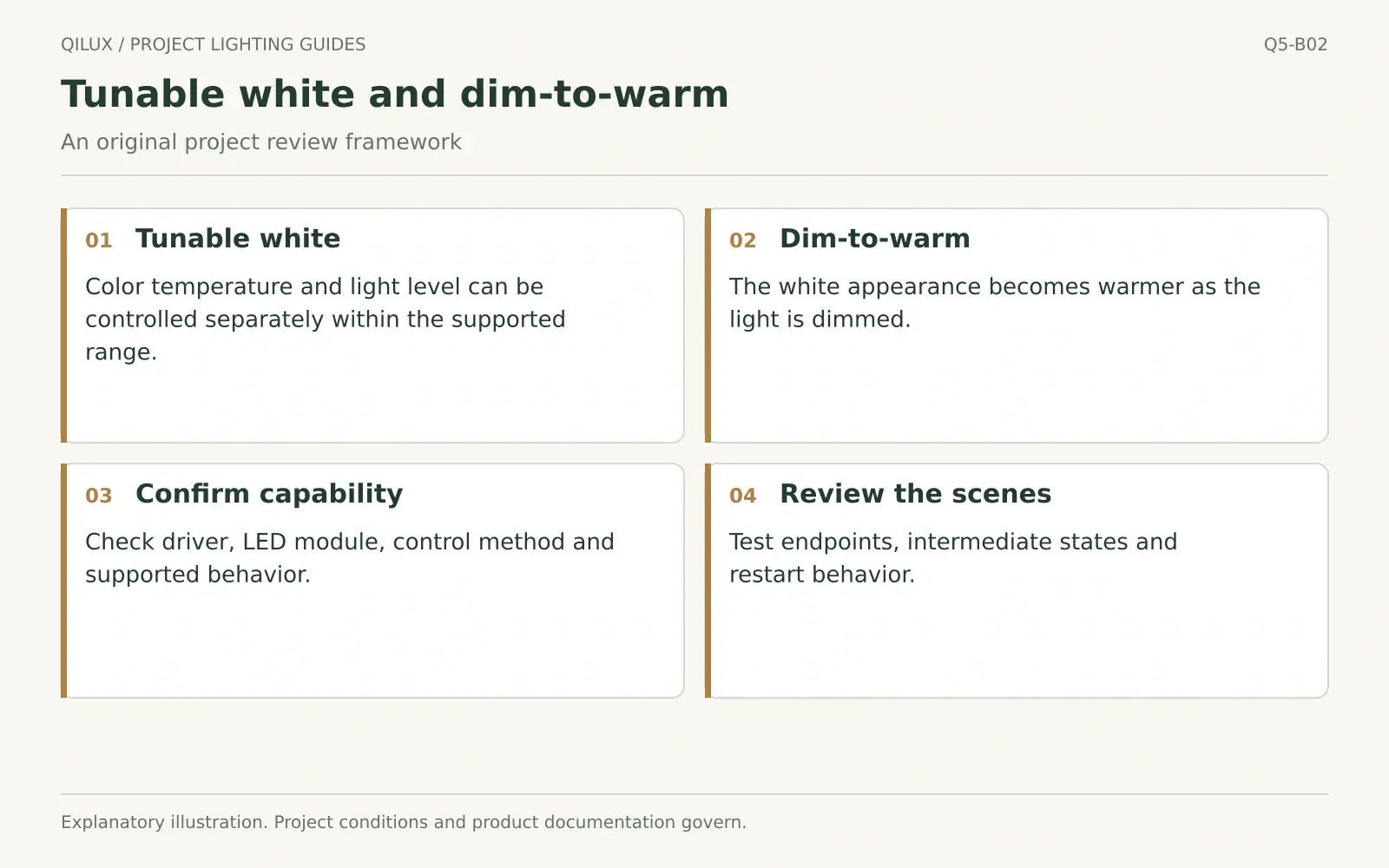
It is enough when the room only needs to get warmer as it gets darker. That covers most restaurants, most bars, most guestrooms and most residential projects. It is not enough when the room must also go cooler than its base CCT — a breakfast room that needs 4000 K in the morning, or a meeting room used for colour review.
The decision test is whether any scene needs a CCT above the fixture’s full-output value. If the answer is no, dim-to-warm is cheaper, simpler and more reliable. If yes, tunable white is the only option that does it without a second fixture layer.
There is a hybrid worth knowing about: fixed CCT with a separate warm decorative layer. A restaurant at 3000 K general with 2200 K pendants over the tables gets an evening feel without touching the control system, because the two layers are simply dimmed against each other. It is the cheapest route to the visual result and the easiest to maintain, though it cannot follow the daylight through the day.
A few cautions apply to dim-to-warm. The shift curve is not standardised, so fixtures from two suppliers will not track together as they dim. And CRI usually falls at the warm end, because the shift is achieved by favouring the warm channel; check R9 at 10% output rather than at 100%.
次のステップ
Tunable white is a control and commissioning decision as much as a fixture decision, so the useful starting point is the scene list and the areas that need to change CCT. Send the room types, the scenes, and the control system already specified, and the team will return the fixture options with their CRI at three points across the range, plus a commissioning scope. Start at 機能ページ, or see the wider package under hospitality lighting.