Most glare complaints in hotels are not about too much light. They are about one bright square millimetre of LED in the wrong place. A 12 W downlight at 3,000 cd/m² will be complained about in a dim lounge and never noticed in a bright lobby, because glare is a ratio, not a quantity.
UGR is the number that captures that ratio for a standard observer, and EN 12464-1 sets limits by task: 19 for offices, 22 for dining, 25 for circulation. This guide covers what UGR measures, what it misses, and the placement rules that decide whether a guest notices the ceiling at all.
1. Discomfort vs disability glare
Discomfort glare makes you want to look away. It does not stop you reading the menu, but it makes the room tiring after twenty minutes. Disability glare actually reduces what you can see: contrast drops, detail disappears, and the task becomes harder. Both come from the same physics and are fixed by different means.
Disability glare in interiors usually appears as veiling reflection. A downlight behind a seated guest reflects off a glossy menu, a polished table or a laptop screen and lays a bright veil over the text. The fix is geometric: move the source out of the mirror angle, change the surface sheen, or shield the fitting so the reflection is weaker than the task contrast.
Discomfort glare is what UGR quantifies, and it is the one that generates complaints in guestrooms and restaurants, because the guest has time to notice. A fitting that scores 25 in a corridor nobody lingers in will pass; the same fitting over a dining table at 25 will be reported within a week.
2. UGR and how it is calculated
Unified Glare Rating combines four terms: the luminance of each source, its apparent size as seen by the observer, its position in the field of view, and the background luminance behind it. The published form is UGR = 8 log₁₀ [(0.25 / Lb) × Σ (L² ω / p²)], where L is source luminance in cd/m², ω is the solid angle the source subtends, p is the position index and Lb is background luminance.
You do not need to evaluate it by hand, but the exponents explain the behaviour. Source luminance is squared, so doubling it adds about 2.4 UGR points. Halving the apparent area of the source subtracts about 2.4. Raising background luminance lowers UGR, which is why the same fitting is comfortable in a bright room and unacceptable in a dark one.
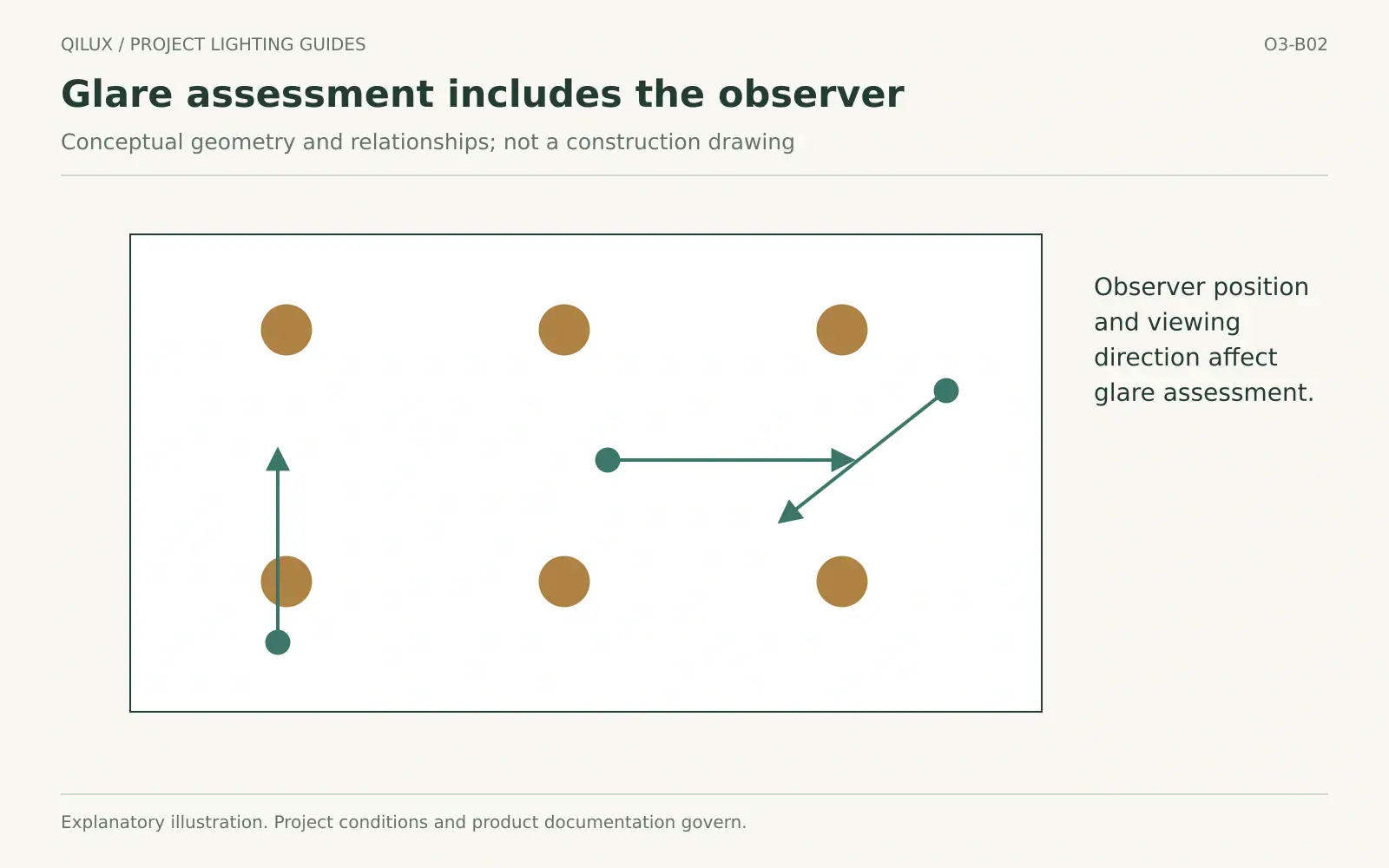
Two limits are worth knowing. UGR is calculated for a standard observer at a defined position, usually the back wall of the room, looking horizontally. It says nothing about a guest lying in bed looking at the ceiling. And a UGR value is a property of the whole installation, not the fitting: the same luminaire can score 16 in one room and 23 in another with darker surfaces and closer spacing.
| 空間 | UGR上限 | Basis |
|---|---|---|
| Open office, writing | ≤ 19 | EN 12464-1 |
| 会議室 | ≤ 19 | EN 12464-1 |
| Restaurant, dining | ≤ 22 | EN 12464-1 |
| Hotel lobby | ≤ 22 | Practice; 19 if desks face the ceiling |
| Corridor, staircase | ≤ 25 | EN 12464-1 |
| Bedhead reading | ≤ 16 | Practice; source within 1 m of the eye |
| Bathroom mirror | ≤ 19 | Practice; vertical task, close viewing |
Software handles the arithmetic. DIALux and Relux both produce a UGR table against standard observer positions, and the useful number is the worst cell rather than the average. A restaurant layout averaging 20 with one position at 24 will still get a complaint from the table under that cell.
The bedhead figure is the one that gets missed. At 1 m viewing distance the source subtends a large solid angle, and the position index is high because the guest is looking almost directly at it. A fitting that measures UGR 19 at the door can be effectively 24 at the pillow.
3. Luminance limits by application
UGR needs software; luminance needs a meter and a rule. Where a source is directly visible, keep its luminance below about 1,000 cd/m² at normal viewing angles. Above that, the eye adapts to the room and the source reads as a point of discomfort.
The limit moves with angle. A source 45° above the sightline can run to 3,000 cd/m² and still be tolerable if it is small, because the position index is low and the eye is not adapted to it. The same source 10° above the sightline is unacceptable at half that luminance. This is why recessing works better than dimming: it changes the angle, and dimming only changes the quantity.
| Condition | Source luminance | Typical fix if exceeded |
|---|---|---|
| Direct view, seated, 1–2 m | < 1,000 cd/m² | Deeper recess, honeycomb, lower output |
| Direct view, 45° above sightline | < 3,000 cd/m² | Snoot, cross-louvre, re-aim |
| Reflected in a glossy surface | < 500 cd/m² at the mirror angle | Move the fitting, change the sheen |
| Adjacent to a dark ceiling | Ratio < 10:1 to ceiling | Raise ambient, add a wash layer |
| Television or monitor wall | < 200 cd/m² behind the screen | Bias light, no downlight in the mirror angle |
Ceiling brightness matters as much as the fittings. A ceiling at 20 cd/m² with a 3,000 cd/m² downlight set into it produces a 150:1 contrast at the aperture. Washing the ceiling to 60–80 cd/m² before adding the downlights can drop the perceived glare without changing a single fitting.
4. Shielding angle and deep reflectors
The shielding angle is measured from the horizontal to the line joining the lamp to the edge of the aperture. A 30° shielding angle means you cannot see the LED unless you are 30° or more below the ceiling plane. Practice for hospitality runs 30°–45°: 30° for general ceilings at 2.7 m, 40–45° where guests sit close to the fittings.

Depth is the cheap version of shielding. A 90 mm aperture with the LED set 60 mm back gives a shielding angle of atan(60 / 45) ≈ 53°, well above the 30° minimum, and that geometry costs nothing but a deeper ceiling void. A baffle or reflector set 40 mm or more behind the aperture typically removes 3–5 UGR points at the same output, because it cuts the solid angle at shallow viewing angles.
A honeycomb accessory adds another 2–3 points and costs 8–12% of the lumens. A snoot on an accent fitting does the same job for a 15° spot at the price of a tighter aim tolerance.
There is a trade-off to state plainly. Deep recesses and baffles reduce efficiency. A 45° shielded fitting may deliver 15% fewer lumens than the open version of the same product, so the wattage has to rise to hold the lux. That is still the right trade in a guestroom: 15% more power for 4 fewer UGR points is a good exchange, and the guest experiences the second number.
For fixtures that must stay shallow — 100 mm ceiling voids, heritage ceilings, cove details — the alternative is a diffused optic with a large emitting area. Low luminance over a big area beats high luminance through a small hole, every time, at the same lumen output.
5. Placement mistakes in hotels
Most bad glare is a layout error, not a product error. These are the ones that recur on snag lists.
- A downlight directly above the pillow. The guest lies under it and looks straight at the aperture. Move it 300–400 mm toward the room centre, or swap it for a shielded reading light.
- A mirror light at standing eye height. The source sits exactly in the reflection line. Put the light above the mirror line, or use two side lights at 15–20 cm from the mirror edge.
- Track spots aimed across the room rather than at a wall. Every guest who looks toward the bar sees the lamp. Aim at the merchandise, the wall or the table, never at the seating.
- Corridor downlights placed 200 mm from the door reveal. The fitting is visible from inside the room when the door is open. Centre them in the corridor width instead.
- An uplight in a 2.6 m room. The ceiling becomes a 2 m² source of 200 cd/m² at close range. Uplighting needs height to work.
- A wall washer 100 mm from the wall. The wall goes to 800 cd/m² in a bright band at eye height. Use the 0.6–1.0 m offset that the optic was designed for.
The test is to sit where the guest sits, at night, with the room at its evening scene, and look around for ten seconds. Anything that makes you want to move your head is a defect, whatever the calculation said.
6. Testing glare on site
Commissioning usually checks lux and stops. Add three checks and most glare complaints disappear before opening.
Photograph the ceiling at low exposure. A phone camera with the exposure pulled down two stops shows which fittings are bright points and which are diffused. It is a crude luminance map and it matches what guests notice.
Measure luminance where it matters. A luminance meter aimed at the aperture from the seated position gives the number that matters, not the one in the datasheet. Where no meter is available, photograph the fitting next to a known white card and compare the two exposures — rough, but enough to separate 800 cd/m² from 4,000 cd/m².
Re-run the calculation with the installed finishes. UGR depends on background luminance, and the wall paint on site is rarely the reflectance assumed in the design stage. A room finished in dark timber and matte black can add 2–4 UGR points over the calculation done at 70% reflectance.
Check the dimmed scene too. At 1–3% output many drivers move to low-frequency PWM, and a source that is comfortable at full output can flicker at the level the hotel actually runs at dinner. SVM ≤ 0.4 is the EU limit, and it is worth asking for the driver’s dimming curve rather than trusting the headline.
Where a layout is already built and the complaint is real, the least disruptive sequence is: re-aim first, add a shield or honeycomb second, reduce output third, change the fitting last. The first two cost hours; the last costs a purchase order.
次のステップ
Glare risk is cheapest to review on the drawing, before the ceiling is closed. Qilux reviews layouts against EN 12464-1 glare limits, checks source luminance at realistic viewing positions, and proposes shielding or re-aiming where a fitting sits in a guest’s sightline. Send the reflected ceiling plan and the finishes schedule through 当社のエンジニアリング対応ページ and the review comes back annotated by room.
For the fixtures themselves, the deep-set downlight range covers 30°–45° shielding with baffle depths from 25 mm to 60 mm, and the bedroom lighting range includes shielded reading lights rated for close viewing. Background on how the numbers relate to delivered illuminance is in the lux levels reference.