IP44 and IP65 are separated by one digit in each position, and by about 25% in unit cost. The practical difference is splash versus jet: IP44 survives water thrown at it from any direction, IP65 survives a directed jet and keeps dust out entirely. Most hotel bathrooms need IP44. Most outdoor terraces need IP65. Getting the two the wrong way round is either a compliance failure or an unnecessary heat problem. This page sets them side by side and says where each one belongs.
1. What IP44 protects against
IP44 is two test results. The first digit, 4, means a 1 mm wire or screw cannot enter far enough to touch live parts or moving parts. The second digit, 4, means water splashed against the enclosure from any direction produces no harmful ingress.
The splash test uses an oscillating shield that sweeps water across the fitting at 10 litres per minute for five minutes, with the fitting on a turntable. It is a gentle, wide, low-pressure test. It approximates a shower splash, a wet hand, or rain blowing onto a sheltered wall — not a hose.
That is exactly the condition in a guestroom bathroom. A basin tap, a wet towel, condensation running down a mirror: none of it delivers pressure. IP44 is the minimum for zones 1 and 2 of a bathroom under IEC 60364-7-701 for that reason.
Two things IP44 does not cover, and both are common in bathrooms. It says nothing about corrosion, so a plated steel body will fail at the edges before the gasket does. And it says nothing about condensation inside the housing, which is where mirror lights in a steamy room usually die.
2. What IP65 adds
The first digit moves from 4 to 6, which is a different test rather than a bigger number. At 6 the enclosure is dust tight: no dust enters at all, tested with talcum powder in a chamber under negative pressure for up to eight hours. At 5 dust is limited but present; at 6 there is none.

The construction changes more than the datasheet suggests. An IP65 body usually has a moulded gasket channel with a defined compression, a cable gland rated to the same IP, and screws torqued to a figure written on the assembly drawing. An IP44 fitting usually has a flat gasket seated by hand and an open back. That difference, not the digit, is what determines whether the fitting still seals in year five.
The second digit moves from 4 to 5, which introduces a 6.3 mm nozzle at 12.5 litres per minute, held 3 m away for three minutes. That is a directed jet, and it is a harder test than splash in every respect except coverage: the spray hits one area rather than the whole body.
| IP44 | IP65 | |
|---|---|---|
| Solids | 1 mm objects | Dust tight, no ingress |
| Water | Splash, 360°, 10 L/min, 5 min | Jet, 6.3 mm, 12.5 L/min, 3 min at 3 m |
| Typical construction | Gasket on the diffuser, unsealed back | Sealed body, gland, compressed gasket |
| Ventilation | Usually open, heat escapes | Usually closed, heat retained |
| Serviceability | Lens removable, LED board accessible | Sealed, often non-serviceable |
| Hotel use | Bathroom zones 1–2, covered balcony | Exposed terrace, pool deck, kitchen, façade |
3. Where IP44 is enough
IP44 is enough wherever water arrives as splash and the space is otherwise dry. In a hotel that covers guestroom bathrooms, vanity lights beside a basin, mirror lights above a sink, and a balcony with a real roof over it.
It also covers the inside face of an external wall under a canopy, and the underside of a deep soffit where the fitting is set back at least a metre from the edge. In those positions the water never arrives with pressure, and the dust loading is low enough that the missing 1 mm and the missing dust test do not matter.
The other case where IP44 wins is service. A bathroom fitting with a removable diffuser can be cleaned and re-lamped; a sealed IP65 unit usually cannot. In a hotel with 300 bathrooms, a fitting that can be opened and cleaned by housekeeping is worth more than a rating nobody needs.
4. Where IP65 is required
Move to IP65 as soon as one of four conditions appears: the fitting can be hit by a hose, it faces open sky, it sits in a space with grease or chlorinated vapour, or the local authority requires it for a public wet area.
In practice that means exposed terraces, pool decks, outdoor showers, spa and steam rooms, commercial kitchens, refuse areas, loading docks and façades. Public bathrooms in hotels also belong here more often than they are specified: housekeeping hoses the walls, and a hose at close range is an IPX5 event, not an IPX4 one.
Exterior terraces and other exposed project work are usually specified as a package, with fixings and cable routes resolved alongside the fittings; that is the level at which commercial project lighting is normally procured.
Spa and steam rooms are the third case, and the one most often missed. The ceiling of a steam room is not underwater and does not see a jet, so teams specify IP44 by the letter of the rule. It then fails because chlorinated vapour condenses on every cold surface, and the real requirement is IP65 with a C4 corrosion class and a stainless fixing — the rating alone does not save the finish.
There is a compliance angle too. Some authorities and some insurers read IEC 60364-7-701 conservatively and require IPX5 in zone 1 of a public bathroom where a shower head can be directed at the wall. If the local inspector holds that view, IP44 will fail at handover regardless of what the standard permits.
5. Why IP65 can trap heat and moisture
A sealed fitting keeps water out and keeps heat in. Closing a 15 W downlight from IP20 to IP65 typically raises the driver case temperature by 8–12 K, because the housing that stops the jet is also a barrier to convection. Electrolytic capacitor life roughly halves for each 10 K rise, so the same driver can drop from 50,000 hours to 25,000 hours without any change to its specification.
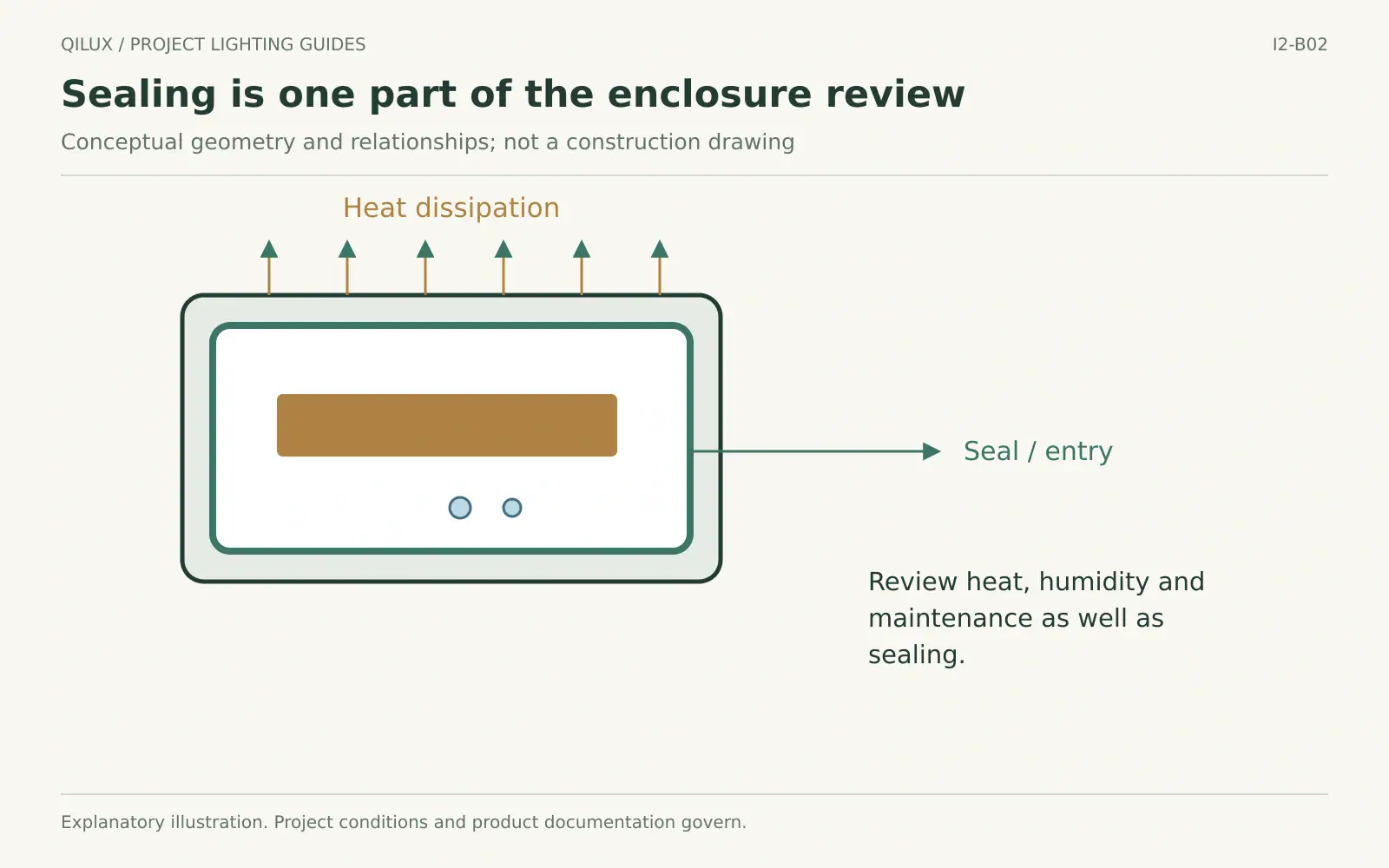
The second problem is moisture that got in during construction. A sealed body installed on a humid day traps that air. When the light runs, the air expands and pushes against the gasket; when it cools, the pressure reverses and pulls damp air back through the cable entry. Over a season, water accumulates at the lowest point inside the housing, which is usually the driver.
This is why good exterior fittings have a breather valve — a small ePTFE membrane that passes vapour but not liquid water — and why a potted driver is worth paying for on a coastal site. It is also why IP65 in a dry interior is a net negative: you pay more, run hotter, and gain nothing.
The gasket matters more than the number on the box. Silicone holds its compression from roughly −40 °C to 200 °C and resists UV; EPDM is cheaper and adequate indoors but hardens outdoors; neoprene degrades in oils and chlorine. A compressed gasket that has taken a permanent set no longer seals, whatever the report says.
There is a third cost that rarely enters the comparison: cleaning. An IP65 fitting with a bonded lens cannot be opened, so when the inside of the glass fogs with mineral deposits there is no way to clean it. In a hard-water city that can halve the useful life of a mirror light. An IP44 fitting with a removable diffuser can be cleaned in five minutes by housekeeping. Where the water exposure is splash only, that serviceability is worth more than the extra digit.
6. Choosing by location, not by habit
The habit in most practices is to write IP65 everywhere “to be safe”. It is not safe, it is expensive and thermally worse. Choose by the water source and the cleaning method, then add one step of margin only where the cleaning regime is unknown.
| Position | Minimum | Sensible choice |
|---|---|---|
| Bathroom, zone 0 (in the tub or tray) | IPX7、SELV 12 V | IPX7, SELV, 316 trim |
| Bathroom, zone 1 (over bath or shower, to 2.25 m) | IPX4, IPX5 if spray is direct | IPX5 in public bathrooms |
| Bathroom, zone 2 (0.6 m beyond zone 1) | IPX4 | IP44, IP65 if hosed |
| Vanity or mirror light, guestroom | IP44 | IP44 with a serviceable diffuser |
| Balcony with a roof | IP44 | IP44, C4 finish on the coast |
| Open terrace or pool deck | IP65 | IP65, IK08, 316 fixings |
| Kitchen washdown wall | IP65 | IP66, IP69K if a pressure washer is used |
Two lines on that table are worth arguing about at design stage rather than at handover. A guestroom bathroom is IP44 and stays IP44; upgrading it costs money and shortens driver life. A public bathroom is usually IP65 even though the standard only asks for IPX4, because the cleaning method decides the real exposure.
If you are unsure, ask two questions. Can a hose reach this fitting? Can rain reach it at an angle? Two noes means IP44. Either yes means IP65. Both yes, on a coast, means IP65 with a corrosion class and a stainless fixing, and that is a materials decision rather than a rating decision.
次のステップ
For bathroom and wet-area work, the fixtures are grouped by the zone they are built for, with the gasket material and cable entry listed alongside the rating. Start from the wet-area lighting range, or send the room schedule through the project enquiry desk and you will get a fixture list with IP, SELV and finish resolved per room type. The zone boundaries themselves are set out in bathroom lighting zones and IP requirements, and the full rating-by-rating table is in the IP rating chart.