

تثبت DALI جدواها في الفندق عندما يتعين على خط واحد تشغيل 64 وحدة إنارة قابلة للعنونة كلٌّ على حدة، بينما يرغب مكتب الاستقبال في أربعة مشاهد إضاءة عبر 180 غرفة. يتكوّن الناقل نفسه من سلكين، من دون قطبية، بميزانية طاقة قدرها 250 ملي أمبير وحدّ أقصى للطول يبلغ 300 متر. لكن ما يكلّف فعليًا هو جدول العنونة وأسبوع التشغيل الأولي. يغطي هذا الدليل الخاص بتعتيم DALI قواعد التوصيلات، وبنية العناوين والمجموعات، وما يضمنه اعتماد DALI-2 فعليًا، ومشاهد الفندق التي تصمد أمام واقع أعمال التدبير المنزلي.
1. ما الذي يتيحه DALI ولا يتيحه 0-10V
إشارة 0-10 فولت أحادية الاتجاه. يرسل مُعتم الإضاءة جهدًا يتراوح بين نحو 1 و10 فولت، ويتبعه المشغّل. ولا تعود أي إشارة. فإذا تعطلت وحدة إنارة، لا يعرف نظام التحكم بذلك إلى أن يشتكي أحد النزلاء أو يمرّ المشرف في الممر.
DALI ناقل رقمي يعمل بجهد 16 فولت. لكل جهاز تحكم على الخط عنوان قصير، ويمكن لوحدة التحكم أن تستفسر من كل جهاز عمّا يفعله. هذا التغيير وحده — أي التغذية الراجعة — هو ما يميّز نظامًا يمكن صيانته عن دائرة لا يمكن فعل شيء حيالها سوى استبدال المصابيح.
الأرقام أدناه هي التي تحسم المواصفات. فلا تصمد ادعاءات الكتيبات التسويقية أمام خط امتلأ ثلثاه بالفعل.
| المعلمة | 0-10V | DALI-2 | DMX512 |
|---|---|---|---|
| الإشارة | جهد تناظري، أحادي الاتجاه | رقمية، ثنائية الاتجاه | رقمية، أحادية الاتجاه (مع خيار RDM) |
| الأسلاك | 2، من دون قطبية | 2، من دون قطبية، ناقل بجهد 16 فولت | 3-5، محمية |
| العنونة | لا توجد؛ تُحدَّد المناطق حسب الدائرة | 64 عنوانًا قصيرًا لكل خط | 512 قناة لكل نطاق عالمي (Universe) |
| الحد الأدنى المعتاد للتعتيم | 1-5% | 0.1-1% | 0.1% |
| ملاحظات | لا شيء | تعطل المصباح، ودرجة حرارة المشغّل، وساعات التشغيل | محدودة، عبر RDM فقط |
| المشاهد | في وحدة التحكم فقط | 16 لكل جهاز، مخزّنة في المشغّل | في وحدة التحكم المركزية |
| الاستخدام المعتاد | مناطق بسيطة، وتجهيزات منخفضة التكلفة | الفنادق، والتحكم بالمشاهد، وإعداد التقارير | المسرح، والبار، وتأثيرات الواجهات |
هناك نتيجتان مهمتان في الموقع. تُخزَّن المشاهد داخل المشغّل، لا في وحدة التحكم، لذا يمكن للوحة جدارية على الخط نفسه استدعاء مشهد عند تعطل وحدة التحكم المركزية. وتُضبط أزمنة التلاشي لكل جهاز ولكل مشهد، ما يعني إمكانية تشغيل تلاشي مدته 3 ثوانٍ في ردهة الفندق وآخر مدته 0.7 ثانية بجانب السرير على خط واحد، من دون أجهزة إضافية.
المقابل هو تعقيد الإعداد. تُوصَّل دائرة 0-10 V وتعمل مباشرة. أما خط DALI فيجب إسناد عناوين إليه وتجميع الأجهزة وبرمجتها، كما يجب أن يحتفظ أحدهم بهذا السجل طوال عمر المبنى. للاطلاع على تفاصيل البديل التناظري، راجع دليلنا حول تعتيم 0-10 V.
2. توصيلات الناقل: البنية والطول والطاقة
موصلان بمقطع 1.5 مم². لا قطبية، ولا تدريع، ولا مقاومة إنهاء. ينقل الناقل جهداً اسمياً قدره 16 V، ويقتصر تيار مزوّد الطاقة على 250 mA. يستهلك كل جهاز تحكم نحو 2 mA، لذا يستهلك خط يضم 64 وحدة إنارة 128 mA من ميزانية الـ250 mA، ويترك الباقي للمستشعرات واللوحات.
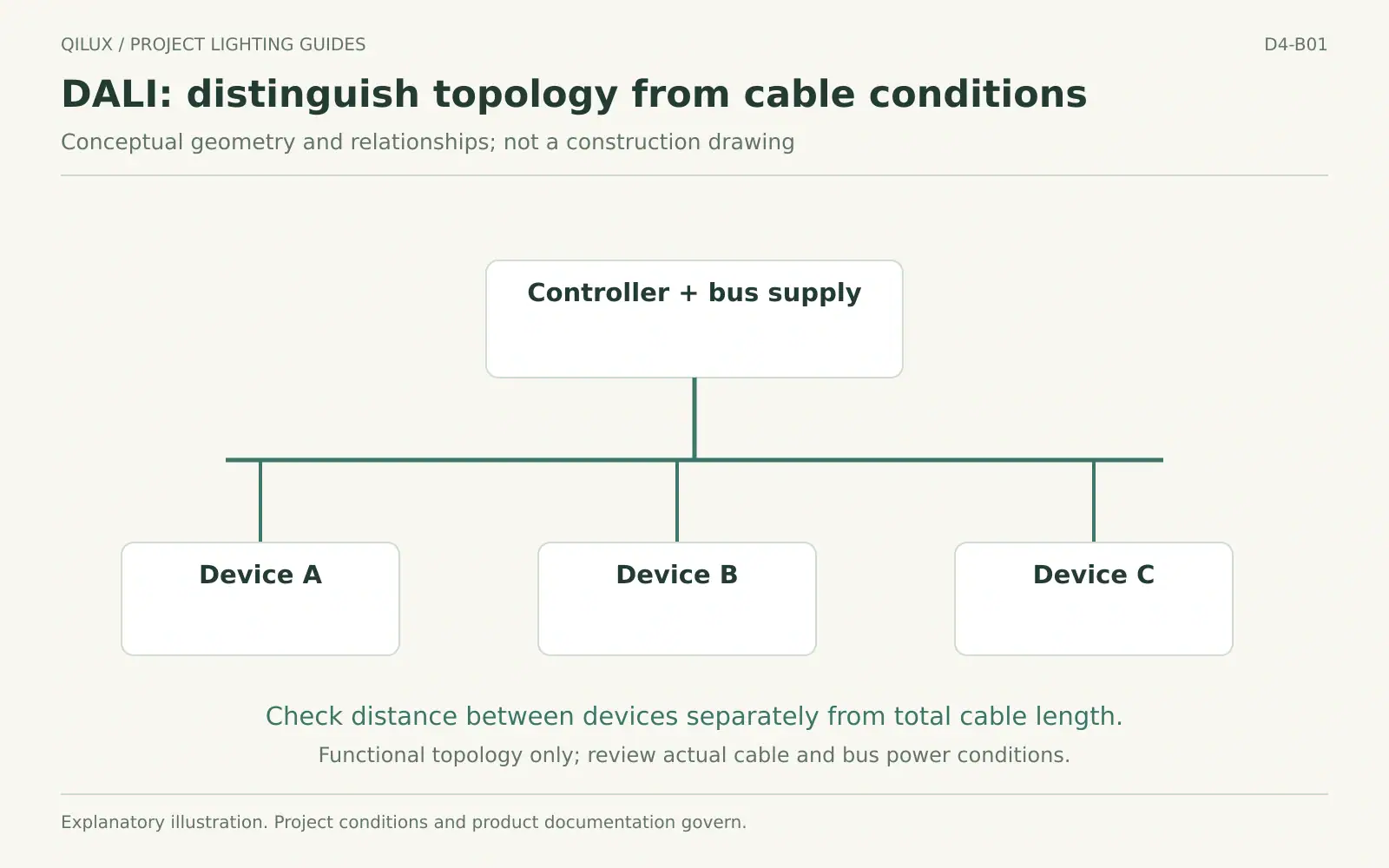
يشير طول 300 m إلى إجمالي طول الكابل، لا إلى أطول مسار. يجب أن يظل هبوط الجهد أقل من 2 V عند الطرف الأبعد، وفي الطابق الموصّل على شكل نجمة، يكون هذا الحد هو العامل المقيّد عادةً قبل بلوغ الحد الأقصى للطول. بنية الناقل مرنة – خطية أو شجرية أو نجمية – لكن التوصيل المتسلسل مع تفرعات قصيرة أسهل في استكشاف الأعطال.
| الخط | وحدات الإنارة (2 mA) | أجهزة التحكم | تيار الناقل | سعة احتياطية قدرها 250 mA |
|---|---|---|---|---|
| ردهة الطابق الأول ومنطقة الاستقبال | 38 | لوحتان (4 mA)، ومستشعر ضوء نهار واحد (10 mA) | 90 mA | 160 mA |
| مطعم وبار الطابق الثاني | 44 | لوحة واحدة (2 mA)، ومستشعر واحد (10 mA) | 100 mA | 150 mA |
| ممرات الطابق الثالث، المستويات 1–3 | 61 | 1 panel (2 mA), 3 sensors (30 mA) | 154 mA | 96 mA |
| L4 guestrooms, floors 1-2 | 58 | 6 room controllers (60 mA) | 176 mA | 74 mA |
Note the control-device column. A DALI presence sensor can draw 10 mA or more, the equivalent of five fittings, and a room controller with a display can draw 20 mA. On a corridor line with 61 fittings you are at 154 mA before the next sensor is added, which is why large floors get two or three lines rather than one long one. A line of 64 fittings leaves roughly 120 mA – six to ten sensors, not sixty.
Keep the bus out of the same conduit as mains unless the cable insulation is rated for it. DALI is not SELV, but it is treated as low voltage and the usual separation rules apply. Put the bus power supply where a technician can reach it without a ladder and a ceiling tile – a riser cupboard, not above a plasterboard ceiling in a guestroom.
D4i drivers carry their own bus supply, so a line of D4i fittings needs no separate PSU. Read the datasheet anyway. The integrated supply is often rated below the 250 mA ceiling, and several D4i drivers on one line share the load rather than adding their ratings together. You still have to budget the devices that are not D4i.
Plan for a line failure. If a bus core is damaged, every fitting on that line loses individual control and falls back to its power-on level – usually 100%, which is the wrong look at 2 am in a corridor. Two shorter lines cost a second PSU and a second gateway port, and they halve the blast radius. On a guestroom floor, keep the bus inside the fire compartment so a fault does not take out rooms either side of a fire door.
Spurs are allowed but should be short. A 5 m spur to a wall panel is normal; a 40 m spur around a ballroom is a voltage-drop problem waiting for a late change order. If the lighting layout is still moving when the containment goes in, pull a spare core to each ceiling void.
3. Addressing: short addresses, groups, scenes
Three numbers run a DALI line: 64 short addresses, 16 groups, 16 scenes. Every fitting gets one short address. Groups are the sets you switch or dim together. Scenes store a level for each group, and the driver holds that table.
The 16-scene limit is the one that catches hotel projects. It is 16 per line, not per room. Put fifteen rooms on a line, give each room five scenes, and you have run out before the second floor.
Two structures work. Give each room its own line – expensive, and only justified for suites and penthouses – or use groups per room and reserve scenes for building-wide states: morning, day, evening, late, housekeeping, emergency. Rooms then use group dimming for local control, and scenes are reserved for what the front of house actually presses.
| Scene | Ceiling | Bedside | Desk | Wall / floor | Fade |
|---|---|---|---|---|---|
| Welcome | 80% | 60% | 50% | 40% | 1.5 s |
| Relax | 25% | 35% | إيقاف | 20% | 3.0 s |
| Read | 40% | 100% | إيقاف | 15% | 0.7 s |
| Night | إيقاف | 3% | إيقاف | إيقاف | 5.0 s |
| All off | إيقاف | إيقاف | إيقاف | إيقاف | 0.7 s |
Levels are percentages of each group’s maximum, not absolute output. That matters because the ceiling group in a 42 m² room and the ceiling group in a 28 m² room are set to different maximums at commissioning; the scene table then works for both.
Addressing is normally done by a commissioning tool that talks to each driver in turn. Auto-enumeration, where the controller numbers whatever it finds, is fast and dangerous: replace a driver two years later and the numbering shifts unless the new device is set by hand. Address by room and write it down.
Label the fitting, not the box. A short address recorded only inside a driver above a fixed ceiling is documentation for a future nobody can reach.
4. DALI-2 and D4i: what certification buys
DALI-2 is the second edition of IEC 62386, with mandatory parts and a certification scheme run through DiiA. A certified product is tested by an independent laboratory against the system parts and the relevant control-gear part – 207 for LED gear – and appears in the public product database.
What that buys is command behaviour. Fade time, arc power resolution, query responses and error handling are consistent across brands, so a driver from one supplier can replace another without reprogramming the line. It does not buy dimming quality. A certified driver can still show visible flicker at 1%, because flicker is a driver design and measurement question, not an interoperability one.
D4i adds four things: an integrated bus power supply, luminaire data that travels with the fitting, energy reporting, and diagnostics – driver temperature, operating hours, failure counters. In a hotel that last item is maintenance data. You can find the ten fittings with the most running hours in a ballroom before they fail, instead of replacing all two hundred.
Ask for the certificate number and the test report, not the word “compatible”. The certificate names the part number that was tested; the report says at what load and voltage. Driver families often have one certified member and several lookalikes sharing a datasheet. The driver options and certificate list we hold sit in our capabilities documentation, and the wider compliance pack is on the الامتثال والاستدامة pages.
One limit to note at tender stage: DALI-2 certification does not cover the control device behind a key-card relay. That interface is a dry contact into a room controller, and the controller is what speaks DALI. If the room controller is not on the bus schedule, nobody owns it.
5. Hotel use cases: rooms, corridors, lobby scenes
A guestroom needs four to six scenes and one presence state. The card switch is a dry contact; the room controller reads it, recalls a scene and starts a departure timer. Bedside reading wants 300 lx at the pillow, which usually means a dedicated reading fitting rather than a ceiling downlight at 40%. The night light runs at 1-3% and should be a separate output so it can stay on when everything else is off.
For the switching side of this – key cards, master switches, bathroom occupancy – our hotel lighting control article covers the sequences. Fixture-level choices for the room are on the guestroom lighting page. This piece stays on the bus.
Corridors hold 100 lx maintained under EN 12464-1. Between 01:00 and 06:00 most operators dim to 30-40% and let presence sensors lift a 20 m segment to 60% ahead of the guest. That is a group command plus a sensor, not a scene, and it is the single most effective energy measure in a hotel that runs 24 hours.
The lobby is where 16 scenes is plenty. Morning, day, evening, late and a cleaning state cover a year of operation. Reception needs 300 lx at the work surface while ambient stays near 200 lx, so the desk gets its own group and its own trim. An astronomical clock moves the evening scene with sunset rather than a fixed 19:00, which matters in a property with a glazed facade facing west.
Bars sit at 150-200 lx and drop to 20% after last orders. Keep the back-shelf on a separate group. It is the one surface guests look at, and dimming it with the room flattens the space into a dark rectangle.
The failure mode in public areas is scene proliferation. Twenty named looks get programmed, nobody remembers what “Evening 2” was for, and staff stop using the panel. Five scenes that everyone understands beat sixteen that need a laminated card.
Divisible ballrooms need one more decision. A partition switch tells the controller which halves are in use, and the groups have to be re-formed per combination: whole room, side A, side B, plus the pre-function area. Four combinations of three groups is twelve states, which fits inside one line if you plan it at design stage and not at commissioning. Get it wrong and the AV contractor will pin the room to a single look for the rest of the fit-out.
6. Commissioning and handover documents
Budget commissioning as a line item, not as a day at the end. A 180-key property with five lines and roughly 1,900 addressable fittings needs one programmer for a week plus an electrician with a ladder. Room-by-room scene setting runs at about 10-15 rooms a day once the schedule is agreed. Public areas take another two days, because the scenes get argued about.
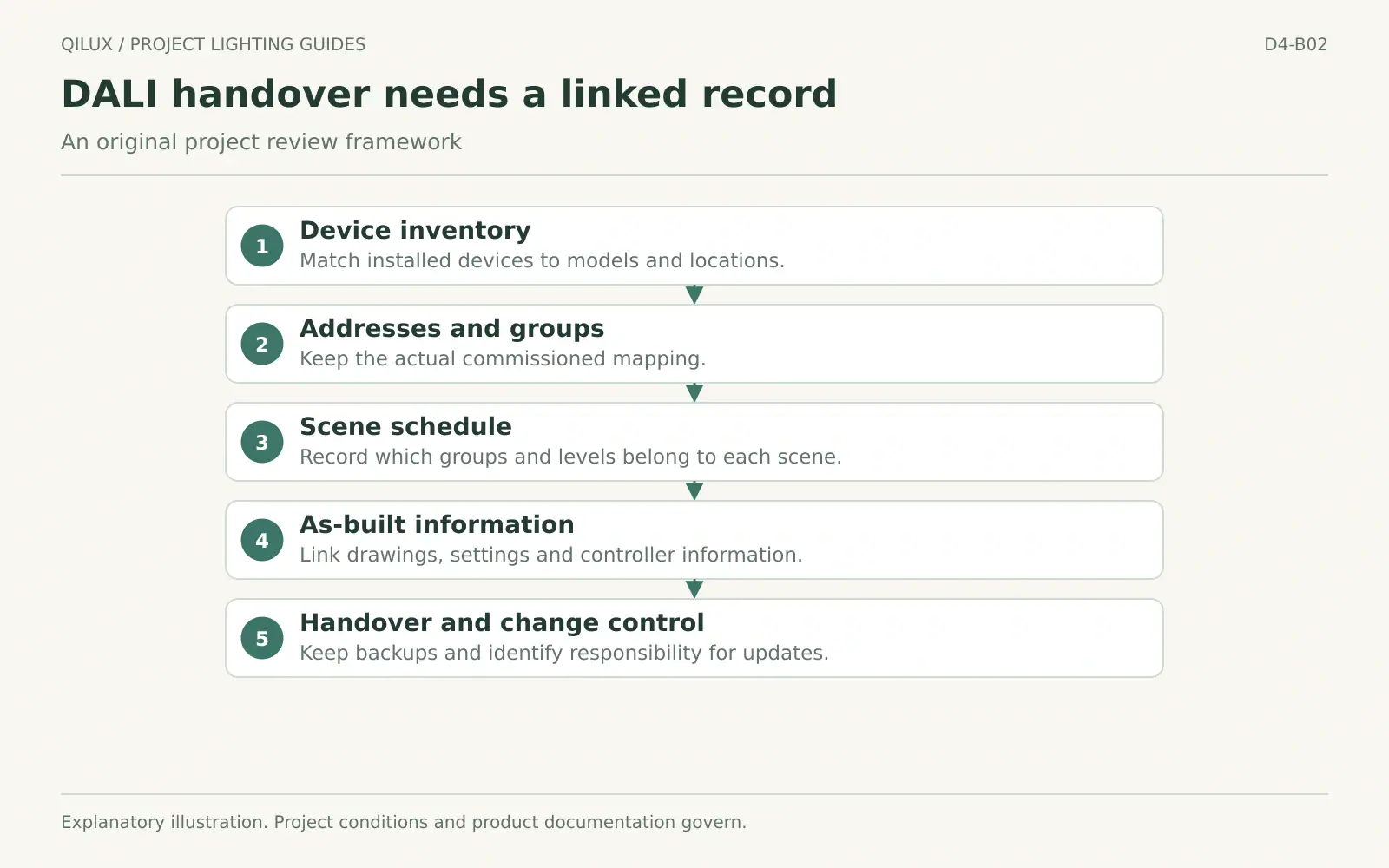
The handover pack should contain, at minimum:
- Addressing schedule: line, short address, room number, fixture type, driver part number.
- Group list with the room or zone each group serves.
- Scene table with levels and fade times per group.
- Control philosophy in plain language: what the card switch, master switch and sensors do.
- As-built bus drawing with PSU locations and line splits.
- DALI-2 certificates for every driver family, and D4i data sheets where diagnostics are in use.
- Spare drivers at 3-5% of count, stored on site with the schedule taped inside the lid.
Test the line before you test the scenes. Measure bus voltage at the far end of every line under full load and record it – anything below 14 V is telling you a PSU is short or a spur is too long. Then recall every short address to 100%, 50% and 10% and watch for a fitting that drops out or jumps. A driver with a failing bus interface often answers queries for a week before it stops responding.
The same failures repeat across projects. Two programmers address the same line and half the rooms answer to the wrong address. A second PSU is added to a line that already has one. A driver is replaced with a non-certified equivalent because it was in stock, and the fade behaviour changes. The scene table is updated in the controller but not in the document, so the next technician re-programs from a wrong baseline.
None of this is exotic. It is the cost of a system that can be maintained, and it belongs in the tender, not in the snag list.
الخطوة التالية
Planning DALI scenes for a hotel? We build drivers, fittings and control interfaces into one schedule, with the addressing and scene tables prepared before the boards arrive on site. Send your room types, ceiling heights and the control philosophy you want through our hotel lighting team and you will get a fixture and driver proposal with the DALI line plan attached.